
Most people think choosing a medical specialty is a single decision you make near the end of med school. We see it as a long chain of moments: the first patient you connect with, the rotation that surprises you, the mentor who challenges you, and the day you realize you actually want to come back and do this work for decades.
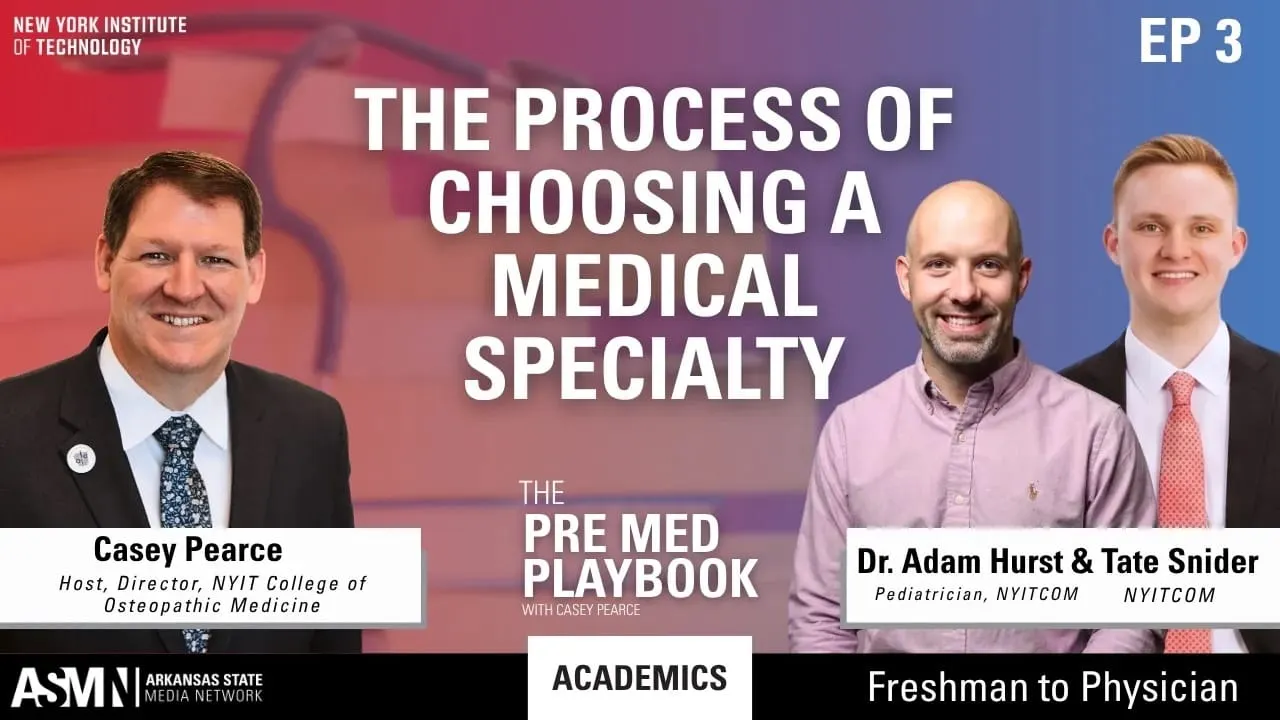
We sit down with Dr. Adam Hurst, an outpatient pediatrician and NYITCOM Arkansas faculty member, and Tate Snider, a graduating medical student heading into emergency medicine. Together, we map the medical school curriculum from the preclinical years (foundations, systems, and learning what “normal” looks like) into the clinical years (rotations, patient care, paperwork, and real-world decision making). If you want a clear overview of how medical training is structured, this is the walkthrough you wish you had earlier.
From there, we get practical about specialty choice: what emergency medicine is really training you to do, why pediatrics involves caring for the whole family unit, and how family medicine and internal medicine differ in patient population, practice scope, and pathways to fellowship. We also talk residency length, board certification, ACGME requirements, and why some fields are more competitive than others, then zoom out to the real-life factors students weigh, call, shift work, geography, and the parts of the job you cannot “buy” with a paycheck.
If you’re pre-med, a med student, or advising someone who is, subscribe, share this with a friend, and leave a review so more future physicians can find it. @Arkansasstatemedianetwork.com.
More About this Episode
Choosing Your Path: The Journey Through Medical Specialty Selection
Deciding on a medical specialty is one of the most significant milestones in a physician's career. In a recent episode of the Pre-Med Playbook Podcast, Casey Pierce from NYIT College of Osteopathic Medicine sat down with Dr. Adam Hurst, a general pediatrician, and student Tate Snider, a soon-to-be emergency medicine resident.
They explored the four-year medical school curriculum and the complex factors that lead a student to their calling.
The Four-Year Journey
Medical school is broadly divided into two phases. Regardless of whether a student wants to be a brain surgeon or a family doctor, the first few years look remarkably similar.
Years 1 & 2: The Preclinical Foundation
These years are spent primarily in the classroom and the lab. Students focus on the normal functions of the human body, from biochemistry and genetics to the microscopic structures of DNA.
- The Goal: Build a baseline understanding of how systems (cardiology, GI, etc.) work when they are healthy.
- The Transition: Second year introduces the abnormal, teaching students how disease processes disrupt the body’s foundation.
Years 3 & 4: The Clinical Clerkships
This is where the real world begins. Students move out of the library and into the hospital or clinic, following physicians (called attendings) through various rotations.
- Core Rotations: Most students rotate through Internal Medicine, Pediatrics, Family Medicine, OBGYN, Surgery, and Psychiatry.
- Differentiating Care: Snider emphasized that these years teach you to differentiate between "sick" and "not sick," applying classroom knowledge to actual patient faces.
Finding the Right Fit: Why Specialty Choice is Hard
Choosing a specialty isn't just about what you like to study; it's about how you like to live and work. The guests highlighted several factors that influence this decision:
1. Patient Interaction Style
- Pediatrics: Dr. Hurst noted that in pediatrics, you have a dual relationship—one with the child and one with the caregiver. It requires a specific demeanor and a love for the family unit.
- Emergency Medicine (EM): Snider was drawn to EM because of its high-intensity teamwork and the stabilization model. In the ER, you meet patients in unexpected, traumatic moments and work to stabilize them for the next step of care.
- Surgery: Surgical fields are often for those who love procedures and immediate, hands-on results. While surgeons have great bedside manner, a large portion of their work happens in the OR under a mask.
2. The Lifestyle Balance
- Shift Work vs. On-Call: Emergency medicine often follows shift work – when you are on, you are 120% focused, but when you check out, you are off. Other fields, like surgery or OBGYN, may require being on-call, where you must be available at any hour for your patients.
- Inpatient vs. Outpatient: Some doctors only see patients in the hospital (Hospitalists), while others, like Dr. Hurst, focus on a day-to-day clinic setting where they see patients for wellness checks and minor illnesses.
Length of Training
The road to becoming an expert varies by field. All paths start with four years of undergrad and four years of medical school, followed by Residency:
- Family Medicine/Pediatrics/Internal Medicine: Typically 3 years.
- Emergency Medicine/OBGYN: Typically 3-4 years.
- Surgical Specialties/Neurosurgery: Can be 5-7+ years.
Final Advice for Prospective Students
Both guests agreed that the secret sauce to success isn't just a high IQ.
- 90% Work Ethic: Snider insisted that medical school is 90% effort and 10% intelligence. "Shoot your shot," he advised.
- Find Your Community: Dr. Hurst suggested finding a smart group of peers to push you. Whether you "marry the smartest person in the room" or just study with them, the relationships you build are what get you through the late nights.
- Ask the "Mess Up" Questions: Don't just ask mentors what they did right; ask them what they messed up. Being informed about the business and lifestyle realities of medicine is just as important as the science.