
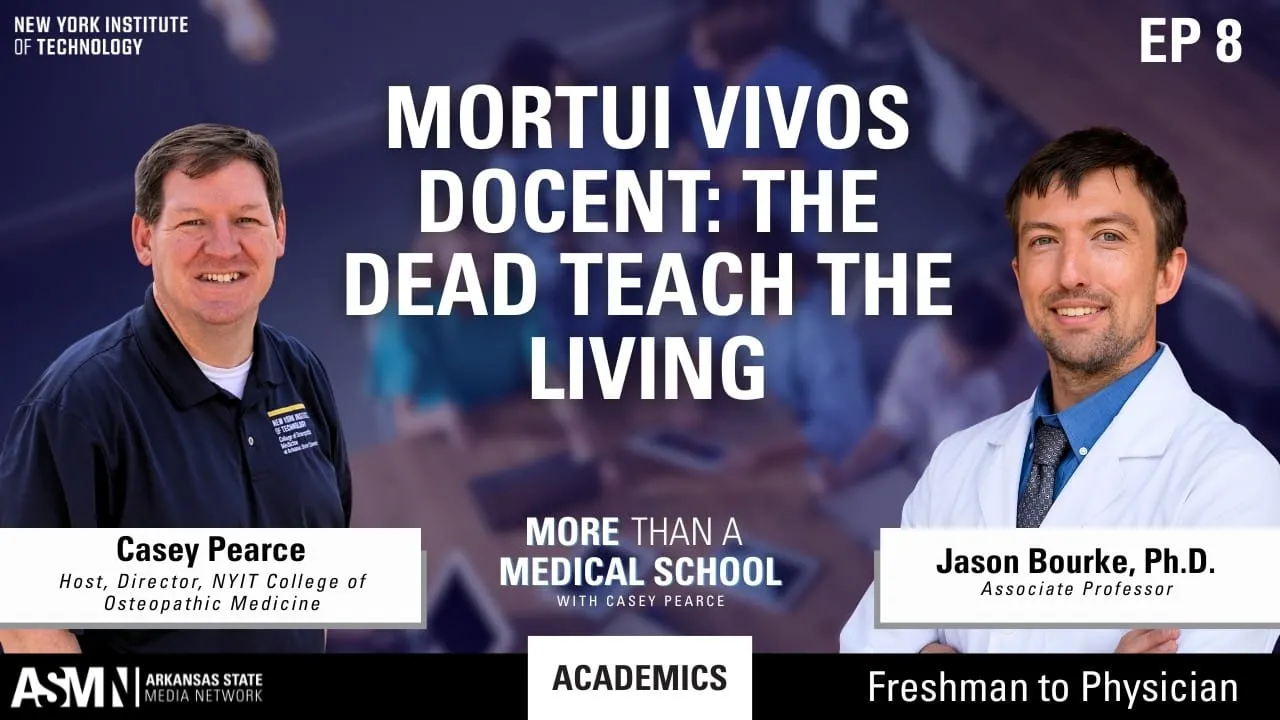
A doctor's first patient should never be a living, breathing human being. With medical schools increasingly shifting toward sanitized digital atlases and 3D modeling, the tactile reality of physical medicine is at risk of getting lost in translation. Dr. Jason Bourke is a vertebrate paleontologist and anatomy professor at NYIT College of Osteopathic Medicine who uses deep-time evolutionary science to teach future physicians how the human body is actually built.
We get into the mechanics of medical education, comparing region-based prosection against traditional dissection models to show how students build a functional three-dimensional map of the body. Dr. Bourke explains how comparative anatomy connects human evolutionary baggage to extinct theropods and crocodilians, using computational fluid dynamics to understand physiology across species. The foundation of his teaching philosophy lies in the ancient Latin phrase mortui vivos docent, the dead teach the living, which reframes deceased body donors not as anatomical specimens, but as a medical student's first true clinical teacher.
Learning anatomy is essentially memorizing a dense foreign language while navigating the heavy emotional reality of working with deceased human donors. To help students process the weight of the cadaver lab, faculty intentionally keep hands and faces covered to preserve tissue and maintain professional boundaries during the hardest parts of the dissection process. Future physicians walk away realizing that anatomical variation is the norm rather than the exception, discovering that real human bodies come layered with fat, fascial anomalies, and decades of physical wear that no textbook or digital table can ever replicate.
If you care about medical school curriculum, comparative anatomy, and the intersection of paleontology and human physiology, you’ll get a lot from this. Be sure to subscribe to the channel and share this episode with anyone interested in the real science of medical training. What is the most fascinating anatomical quirk or evolutionary leftover you've ever wondered about in the human body? Let us know in the comments below.
@arkansasstatemedianetwork.com.