
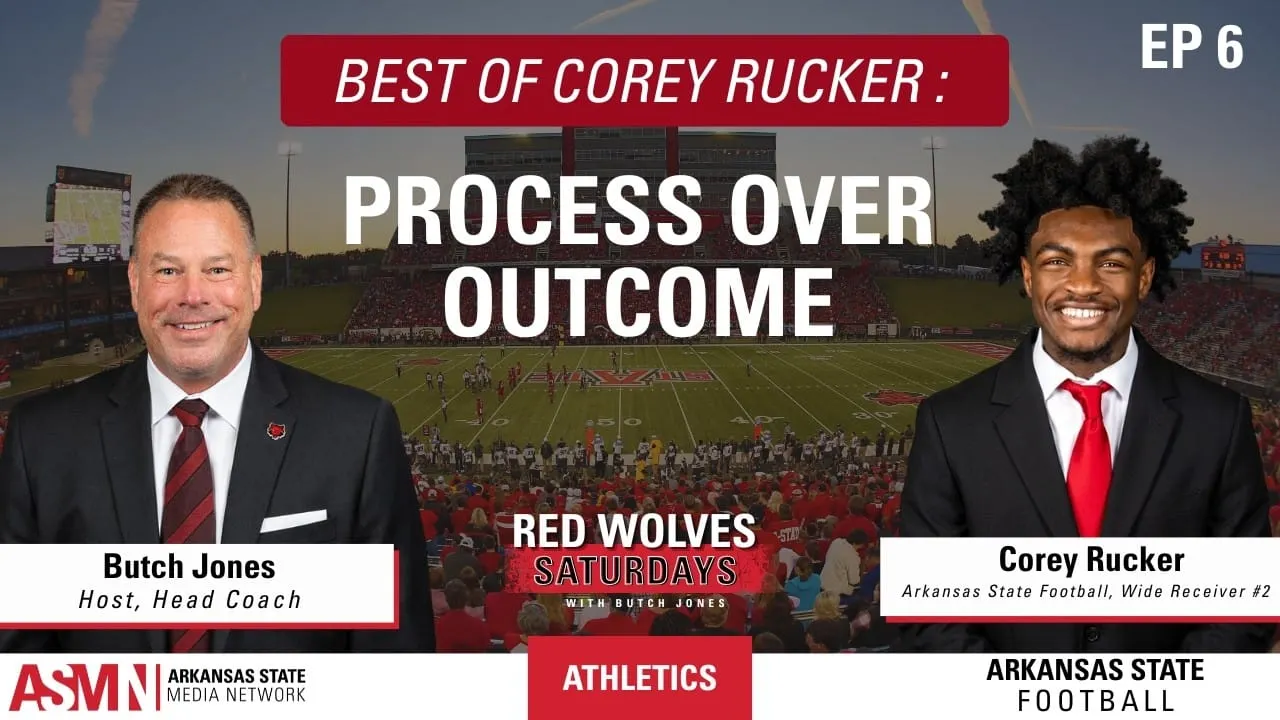
Chasing the wrong opportunity will derail a career faster than any physical injury on the field. As the NFL Draft approaches and the transfer portal continues to upend collegiate athletics, understanding how to navigate career setbacks, rebuild after surgery, and find a community that fosters true development has never been more vital. Today, we are joined by former Arkansas State University standout wide receiver Corey Rucker, one of the most dominant playmakers in Sun Belt Conference history, who brings a masterclass in resilience and elite athletic preparation.
We sit down to examine the tactical realities of preparing for the professional gridiron and the psychology of building a winning football culture. The conversation covers the mechanics of elite speed training, specifically how perfecting 40-yard dash starts and analyzing flying tens proved to pro scouts that game-day velocity translates directly to the stopwatch. We also explore the internal shift required to build a process-driven culture that ignores immediate outcomes, the dynamics of quarterback-receiver trust during breakout games, and the strategic value of an open-door coaching policy. His secret sauce boils down to a profound realization about community: elite development requires an environment where you are valued as a person first, which ultimately drove his unprecedented transfer back to the program where his legacy began.
The path to the NFL is paved with severe physical setbacks, isolation, and the heavy weight of self-doubt. Experiencing a major injury that required surgery while sitting in an unfamiliar program after a high-profile transfer forced a massive reckoning about loyalty and personal support systems. Spending almost a full year away from competitive football demands a brutal mental grind just to feel comfortable and confident running routes again. Viewers will walk away with a clear warning about the dangers of prioritizing external hype over genuine community, along with an actionable mindset shift on how to use personal accountability and rigorous preparation to conquer career-defining moments.
If you care about elite athletic development, process-driven leadership, and building a lasting legacy, you’ll get a lot from this. Make sure to subscribe to the channel and share this episode with anyone looking to understand the gritty reality of college football and professional sports preparation. What is the biggest career pivot you have ever had to make to get back on track toward your ultimate goal? Let us know in the comments below.
@arkansasstatemedianetwork.com
More About this Episode
Building a Legacy in Jonesboro: Cory Rucker on College Football, Culture, and the Path to the NFL Draft
In the world of college football, sustained success is never an accident. It is the byproduct of relentless preparation, unwavering belief, and an intentional focus on culture. When you examine the premier programs across the country, particularly within the competitive landscape of the Sun Belt Conference, the differentiating factor is rarely just raw athleticism. Instead, it comes down to the quality of the people inside the building and their commitment to a process-driven philosophy. Few players embody this standard of excellence, resilience, and leadership quite like wide receiver Cory Rucker.
Watching a young man evolve from an under-the-radar high school prospect into one of the most dominant playmakers in Arkansas State University history is the ultimate reward of coaching. Cory Rucker did not just rewrite the record books in Jonesboro; he helped lay the foundation for a revitalized football program while forging an unbreakable bond with our university and city. As he prepares to take the next step in his journey toward the NFL Draft, his story offers a masterclass in total player development, mental toughness, and the power of finding the right cultural fit.
The Roots of Competitiveness: From Small-Town Mississippi to the Gridiron
Every great athlete carries a foundational drive shaped by their upbringing, and Cory is no exception. Growing up in Benton, Mississippi, located in rural Yazoo County, he learned early on what it meant to compete for everything he got. Being the youngest of three children naturally instills a rugged edge. When you are constantly battling older, stronger siblings just to get first dibs around the house, you develop a natural grit that cannot be coached.
Interestingly, football was not his first athletic love. Like many young athletes with elite vertical leaping ability, his initial dream was to be a basketball player. He saw himself as a hooper on the hardwood, relying on his jumping capability and relentless defensive intensity to lock down opponents. By his own admission, his ball-handling and shooting skills never quite caught up to his defensive prowess. He stayed on the basketball roster primarily to maintain his elite physical conditioning, but around his seventh-grade year, the realization set in that his true ceiling as an athlete was on the football field.
That growing confidence changed everything. As his high school career progressed, his speed and football IQ blossomed, yet he remained largely overlooked by major college football recruiting circuits. He originally committed to play at South Alabama, but when a sudden coaching staff change occurred after a difficult season, he made the mature decision to reopen his recruitment. Our coaching staff at Arkansas State identified his competitive traits and brought him to campus for a late visit. He took a chance on us, and we took a chance on him. That mutual belief set the stage for one of the most prolific wide receiver careers in the history of the Sun Belt Conference.
The Courage to Return: Why Culture and Community Matter More Than Hype
In the modern era of college athletics, the transfer portal has fundamentally altered how players navigate their careers. Yet Cory’s journey features a profound lesson about the importance of community and authentic relationships. Early in his collegiate journey, he made the decision to transfer to South Carolina. On paper, his transition to the Southeastern Conference started with a fireworks display; his very first reception was a explosive 52-yard touchdown pass, and he found the end zone virtually every time he touched the football.
However, success on the field does not always equate to fulfillment off of it. Despite the immediate on-field production, he recognized early on that something essential was missing from his daily life. What was lacking was the deep-seated campus community and the tight-knit family atmosphere he had left behind in Jonesboro. In a high-pressure collegiate sport, an athlete without a genuine support system will eventually feel the void.
That realization led to one of the most meaningful text messages I have ever received as a head coach. Cory reached out directly to express his honest desire to come back home to Arkansas State University. Returning to our program was not an easy path. While away, he suffered a severe injury that required surgery and sidelined him for nearly an entire year. Going twelve months without playing the game you love is an agonizing mental hurdle for any elite competitor.
His rehabilitation process required immense patience. Rather than fixating on immediate outcomes, he bought entirely into our process-driven model. Day by day, he worked to get comfortable with his body, regain his elite change-of-direction speed, and re-establish his timing. Watching him overcome that adversity to return to peak form was a testament to his character. He returned not just to catch passes, but to serve as a foundational pillar for a locker room that was learning how to win.
Defining Moments: Jaylen Raynor, Locker Room Leadership, and Rewriting Records
Building a winning football program requires defining moments where preparation meets opportunity, shifting the entire trajectory of a team. In our journey together over the past few years, several pivotal instances stand out as catalysts for our breakthrough on the gridiron.
One of those undeniable turning points occurred during our hard-fought battle against Southern Miss. In a tightly contested game where momentum swung back and forth, our special teams unit delivered a massive spark when Reed Linder came off the edge to block a punt. That game also marked the true introduction of quarterback Jaylen Raynor to the college football landscape. Jaylen stepped onto the field and delivered a commanding performance that energized our entire sideline.
The most revealing moment, however, happened after the final whistle inside our locker room celebration. In the midst of the joy and chaos, our defensive players hoisted Jaylen onto their shoulders. When you see defensive veterans lifting a young quarterback into the air, you know instantly that the team has found its leader. Players always determine who their leader is, and witnessing that organic endorsement confirmed that our culture and chemistry had reached a new level.
Individual standards also had to be elevated as our team evolved. Prior to the first practice of the following season, Cory and I sat down in my office for a direct, one-on-one meeting. I challenged him as a veteran to set the absolute tone for our offense and told him he needed to go out and have an exceptional practice. He responded by putting together what was likely the finest practice of his entire career. His route running was fluid, his focus was razor-sharp, and every catch was immediately tucked away with purpose.
When you practice with that level of intentionality, execution on game day becomes automatic. In our season opener, the opposing defense elected not to roll secondary coverage to his side of the field, leaving him in single coverage. He took immediate advantage, running a flawless stutter route to haul in a touchdown pass that etched his name into college football history. That single catch pushed him past 4,000 career receiving yards and broke our program's all-time touchdown record. To double down on that milestone by capping off the season with a victory and earning Offensive MVP honors in our bowl game was the ultimate validation of his relentless work ethic.
The Science of Speed: Preparing for Pro Day and the NFL Draft
The transition from a celebrated college athlete to an NFL Draft prospect requires a complete shift in daily structure and focus. Once a player's final collegiate game concludes, the preparation for Pro Day and private team workouts becomes a full-time job where every fraction of a second is scrutinized by scouts and general managers.
For Cory, the primary question mark from professional evaluators never centered on his competitive spirit, his hands, or his ability to create separation at the top of a route. The single metric NFL organizations wanted to verify was his true straight-line speed. Knowing this, he set an aggressive, unambiguous goal for his Pro Day: running the 40-yard dash in the 4.3-second range.
Achieving an elite 40-yard dash time is a precise science that has less to do with top-end velocity and everything to do with biomechanics and explosive starting technique. During his specialized training, evaluation of his flying tens proved beyond a doubt that his top-end speed was elite. Therefore, his preparation was dedicated almost entirely to perfecting his stance, his launch angle, and his first ten yards of acceleration. When an athlete masters the mechanics of their start, the overall time takes care of itself.
Balancing that high-stakes physical preparation with mental recovery is crucial for any prospect entering the draft. Cory utilized his final months before the draft to soak in the experience, balancing rigorous daily conditioning with spontaneous travel across the country. Whether visiting athletic facilities in Arizona, spending time in Omaha, training down in Pensacola, or relaxing in his favorite vacation spot in Hilton Head, South Carolina, he maintained his physical readiness while keeping his mind clear and focused for the professional ranks.
The Blueprint for Total Development: Why Arkansas State Stands Apart
When elite athletes look back on their collegiate careers, their appreciation rarely centers solely on wins, losses, or individual statistics. Instead, they reflect on the environment that shaped them into adults. When asked what advice he would give to high school recruits considering Arkansas State University, Cory outlined a three-pillar blueprint that validates everything our staff works daily to maintain.
- Surrounding Yourself with Exceptional People: From the moment a student-athlete walks into our football facility, they are surrounded by individuals who genuinely care about their well-being. Whether interacting with administrative staff on the top floor, strength coaches in the weight room, or the tireless workers in the equipment and athletic training rooms, our athletes operate in an uplifting, positive environment designed to fuel their success.
- Holistic On- and Off-the-Field Development: True player development must extend far beyond X's and O's. Young athletes need to know they are valued as human beings first and football players second. Our open-door policy is built on this exact principle. A player should feel completely comfortable walking into the head coach's office to talk for hours about life, family, and personal aspirations without ever mentioning football. They should feel at home enough to grab candy off the desk or fall asleep on the office couch after a grueling workout. When you build trust through personal availability, on-field accountability follows naturally.
- An Unrivaled Campus Community: Jonesboro provides a supportive, distraction-free environment where student-athletes are embraced like family. The university and the surrounding city blend seamlessly, creating a safe, energetic atmosphere where young men can focus entirely on their academic, personal, and athletic growth.
That foundational culture allows our team to embrace hard work and thrive under challenging conditions. We constantly teach our players to "make harder our advantage." Whether we are stepping into a hostile road environment against an opponent with an intimidating home-field record or gearing up for a physical 3:30 PM kickoff, our program thrives on adversity. When you start your morning by putting your left foot down, then your right foot down, with the absolute belief that it is going to be a great day, no external challenge can break your focus.
Leaving a Legacy: The Future of Number Seven
As Cory Rucker officially transitions from a college veteran to a professional playmaker, his impact on Arkansas State University remains permanent. He leaves our locker room as one of the most accomplished receivers in Sun Belt Conference history, but more importantly, he leaves as a standard-bearer for what it means to be a Red Wolf. He poured his heart and soul into our campus community, treating every fan, teammate, and coach with respect and dedication.
The journey of an elite athlete does not end when they hang up their collegiate jersey. As he embarks on his professional career in the NFL, he does so with the knowledge that his legacy in Jonesboro is secure. When his playing days eventually conclude many years from now, there will always be a spot waiting for him on my coaching staff in some capacity. He possesses the football intellect, the communication skills, and the personal empathy required to be an extraordinary coach and mentor to the next generation.
Until that day comes, we will watch with immense pride as number seven competes on Sundays. When he reaches the age of thirty and becomes eligible for institutional hall of fame honors, his induction into the Arkansas State Ring of Honor will be a formality. His career stands as a testament to the power of resilience, the importance of community, and the beauty of a process-driven life. To Cory Rucker and to every Red Wolves fan across the country: Wolves up!