
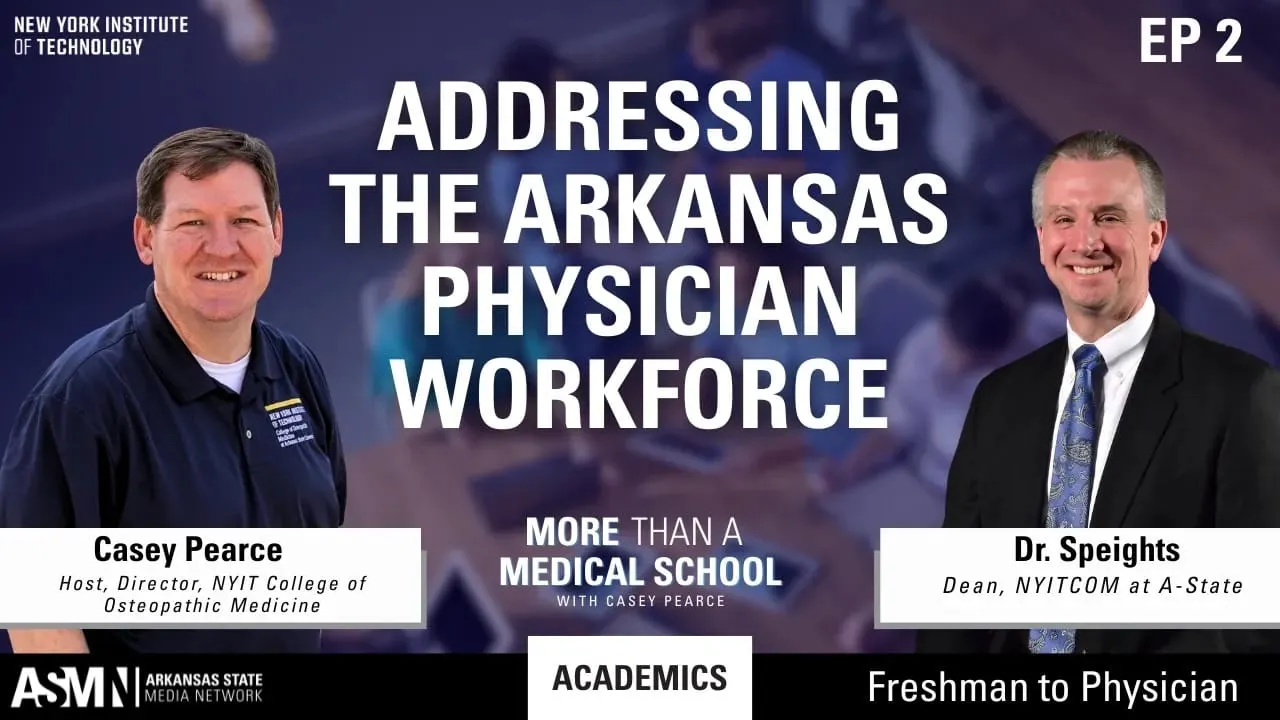
A medical degree can teach you anatomy, pharmacology, and how to pass boards, but it cannot automatically teach you how to change the health of a whole region. That’s the gap we dig into with Dr. Shane Speights, Dean of NYIT College of Osteopathic Medicine at Arkansas State University, as we explain what we mean by “More Than A Medical School” and why fit matters as much as prestige for medical school applicants.
We talk about the mission behind NYITCOM Arkansas and why it was built in the Delta: physician workforce shortages, rural healthcare access, and the need for more frontline doctors in family medicine, internal medicine, pediatrics, and other primary care fields. Dr. Speights shares how a simple media interview about the flu vaccine made him realize the scale of education and advocacy, and why we want future physicians to show up not only in exam rooms but also in community decision-making that shapes health outcomes.
We also break down what it means to be a DO (Doctor of Osteopathic Medicine): the same foundation as MD training, plus a whole-person, prevention-forward mindset and extra hours of hands-on osteopathic manipulative treatment (OMT). From there, we get practical about what truly separates training models, including how community-based clinical rotations can put students directly beside attending physicians, building confidence and readiness for residency.
If you’re choosing between multiple acceptances or wondering where you’ll grow the most, this conversation gives you a clear lens for evaluating mission, training, and impact. Subscribe for more, share this with a premed who’s deciding where to apply, and leave a review with the kind of physician you hope to become. @Arkansasstatemedianetwork.
More About this Episode
Cultivating Physician Leaders in the Delta
The decision to pursue a career in medical education often stems from a realization that the impact of a physician can extend far beyond the individual patient.
For Dr. Shane Speights, the Dean of NYIT College of Osteopathic Medicine at Arkansas State University, this realization was sparked by a simple media interview about the flu vaccine.
While a typical day in a clinic might involve treating fifteen patients, a brief televised segment reached 300,000 people. This moment highlighted the profound importance of community education and the need for healthcare providers to engage with the public.
It shifted his focus toward training a new generation of doctors who view themselves as servant leaders capable of influencing health outcomes on a massive scale.
This philosophy is at the heart of the More Than a Medical School moniker adopted by the institution. While any accredited medical school can provide the foundational knowledge of anatomy, physiology, and pharmacology required to pass boards and enter residency, this program seeks a specific kind of student.
The goal is to produce physicians who are not only clinically proficient but also active in health policy and community advocacy. These are doctors who attend city council meetings, advocate for patients at the state and national levels, and care about the well-being of people they may only pass in a grocery store or at a local football game.
By training students to impact policy and community culture, the school aims to address systemic health issues that clinical visits alone cannot solve.
The school exists as a unique partnership between the New York Institute of Technology and Arkansas State University. Founded by Dr. Barbara Ross Lee, the institution was established to bridge the physician workforce gap in Arkansas and the Delta region.
Historically, Arkansas has ranked near the bottom of the nation in physicians per capita. When the school opened its doors, it was only the second medical school to be established in the state in over 130 years.
By combining the national brand recognition and resources of a long-standing New York institution with the local mission and campus of an Arkansas university, the partnership provides students with a robust support system and a clear purpose.
As an osteopathic institution, the school focuses on the DO, or Doctor of Osteopathic Medicine, degree. While DOs and MDs undergo similar rigorous four-year medical educations and enter the same residency programs, the osteopathic approach emphasizes a holistic mindset.
The guiding principle is to find health rather than simply identifying disease. This involves a focus on wellness, preventative medicine, and the interconnectedness of the body’s structure and function. Students receive hundreds of additional hours of training in osteopathic manipulative treatment, a hands-on approach to removing physical restrictions and promoting healing.
This mindset encourages deep conversations with patients about lifestyle factors like sleep, diet, and mental wellness.
The mission of the school is deeply tied to the needs of the Delta. Osteopathic physicians are statistically more likely to practice in rural areas and enter primary care fields such as family medicine, internal medicine, and pediatrics.
This school consistently graduates students into family medicine at rates nearly triple the national average. By recruiting students from Arkansas and surrounding states, the institution increases the likelihood that these doctors will remain in the region to serve underserved populations.
Even students from distant states often find that the low cost of living and the immense opportunity to make a difference in these communities make the region an attractive place to build a career.
A defining feature of the education here is the community-based clinical training model. Unlike traditional academic medical centers where students may be layered behind residents and fellows, students at this school work directly with attending physicians in community hospitals.
This hands-on environment allows third-year students to be intimately involved in procedures, from delivering babies to prepping patients for surgery. This direct exposure ensures that by the time they reach their fourth-year audition rotations and eventual residencies, they are prepared to hit the ground running with a level of confidence and experience that sets them apart from their peers.
Ultimately, the school invites applicants who want more than just a degree. It is a place for those who wish to invest in a career that balances clinical excellence with social responsibility. By providing a certificate in population health and opportunities in policy fellowship alongside medical training, the school ensures its graduates are equipped to lead.
The curriculum is designed to stretch students, pushing them to become outstanding physicians who are prepared to transform the healthcare landscape of the communities they serve.