
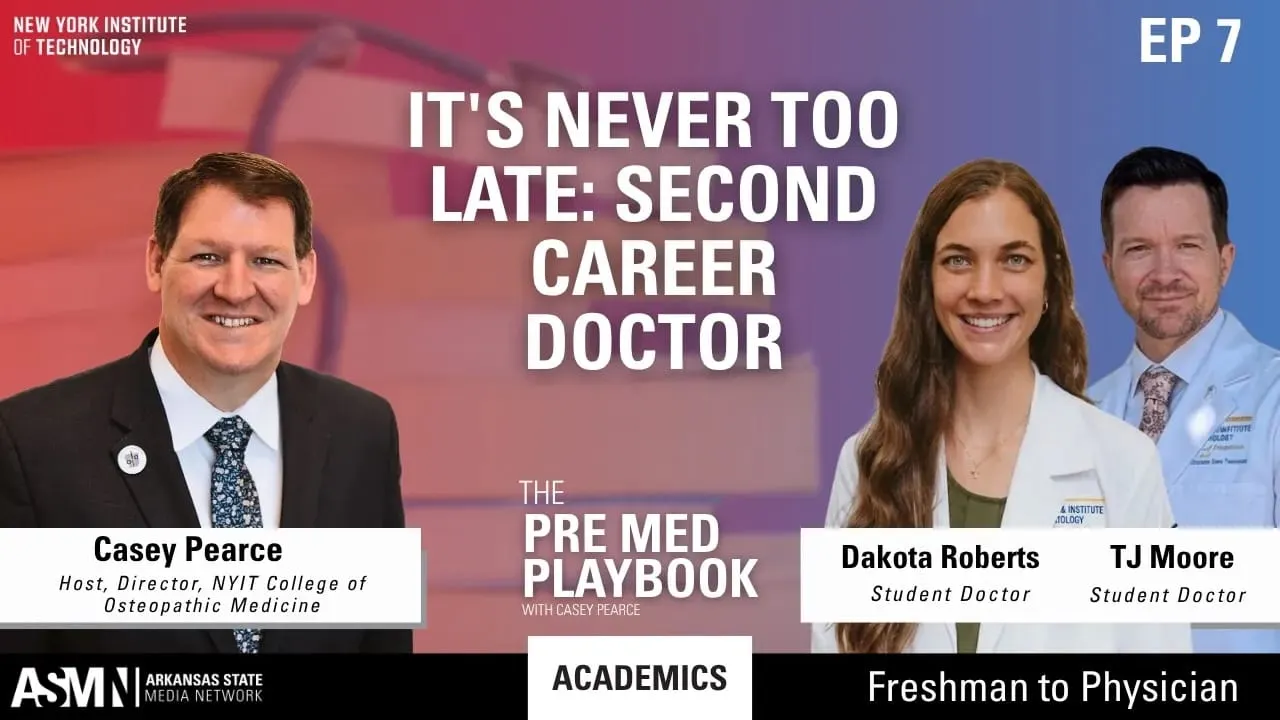
You are going to be that age anyway, so you might as well be that age with a medical degree. The fear of being the "old" student in the lecture hall stops too many capable people from pursuing a career in medicine, but non-traditional applicants actually have a massive hidden advantage. T.J. Moore and Dakota Roberts, two non-traditional medical students at NYIT College of Osteopathic Medicine, share how they pivoted from established careers in public health and the Coast Guard to tackle their first year of med school.
We sit down to break down the actual reality of being an older student in a sea of twenty-somethings. We cover the logistics of relearning how to study after a long gap, dialing in question banks like UWorld and TrueLearn, and balancing standardized patient encounters with real-world military medical experience. The real turning point comes from treating medical school like a standard job, proving that a stable, mature routine often beats raw, anxious energy.
Stepping away from a stable career and salary to become a full-time student again carries real risk and requires serious sacrifice. We look at the grueling reality of eight-hour study days, the challenge of avoiding toxic doom-scrolling on platforms like Student Doctor Network, and the discipline it takes to ignore the noise. You will walk away with a strict framework for building a study system that prioritizes consistency over late-night cramming, plus a needed mindset shift to trust the work you put in.
If you care about pivoting careers, surviving the MCAT application cycle, and optimizing your medical school study routines, you’ll get a lot from this. Make sure to subscribe to the Arkansas State Media Network and share this episode with anyone considering leaping into a second career. What is the biggest mental hurdle stopping you from making a major career change right now?
@arkansasstatemedianetwork.com
More About this Episode
Why It Is Never Too Late for Medical School: A Guide for Non-Traditional Applicants
The journey to becoming a physician is rarely a straight line, and for a growing number of medical students, the path is intentionally winding. While the familiar narrative of medical education involves graduating from high school, completing a four-year undergraduate degree, and transitioning immediately into medical school, admissions committees today see a very different reality. Across the country, and specifically at the NYIT College of Osteopathic Medicine (NYITCOM) at Arkansas State University, classrooms are filled with individuals who have taken extended gap years, served in the military, or pursued entirely different careers before answering the call to medicine.
These non-traditional medical school applicants bring a wealth of real-world experience, emotional maturity, and professional perspective to the study of medicine. Whether stepping away from a career in public health at age 40 or transitioning out of military service in the late twenties, non-traditional students consistently prove that it is never too late to pursue a future as a physician. Navigating this path requires a unique set of strategies, from relearning how to study after years away from academia to filtering out the noise of competitive online forums.
The Evolving Profile of the Modern Medical Student
There is a pervasive myth among pre-medical students that if you do not enter medical school by age 22, your window of opportunity begins to close. In reality, medical schools actively value the diverse life experiences that older applicants bring to the campus and the clinic. An applicant in their late twenties, thirties, forties, or even fifties enters the admissions process with a tested track record of resilience and adaptability.
When individuals arrive at medical school after spending years in the workforce, they often worry that they will feel isolated among younger classmates. However, medical school is a great equalizer. Regardless of age or background, every first-year student faces the same rigorous curriculum, the same challenging examinations, and the same fundamental lifestyle adjustments. This shared experience fosters an immediate sense of camaraderie that transcends age differences. Rather than feeling out of place, non-traditional students typically find that their classmates value their perspective, and the perceived social divide quickly dissolves within the first few weeks of the semester.
Unique Pathways: From Public Health and Military Service to Medicine
The motivations that drive non-traditional applicants back to the classroom are as varied as their backgrounds. For many, the desire to practice medicine develops gradually through exposure to healthcare in other capacities, while for others, it represents the fulfillment of a lifelong ambition that was temporarily placed on hold for financial, personal, or logistical reasons.
Consider the professional journey of career changers who spend years working in public health, infectious disease education, or community outreach before applying to medical school. Working on the front lines of healthcare delivery, managing grant-funded programs, and connecting vulnerable populations to preventative services provides a profound understanding of the healthcare system. These individuals spend years developing interpersonal skills, learning how to communicate across cultural divides, and navigating the complex administrative realities of medicine. When they eventually transition into osteopathic medical school, they already possess a deep appreciation for holistic, patient-centered care.
Similarly, military veterans and individuals who have worked in high-stress clinical environments, such as emergency room medical scribes, arrive with a distinct set of operational skills. Military service teaches adaptability, leadership under pressure, and the ability to execute complex directives in high-stakes environments. When veterans transition from service contracts into medical education, they bring a structured mindset that thrives under the demanding schedule of clinical training. What might feel like an overwhelming workload to a recent undergraduate often feels manageable to someone who has managed operational deployments or worked long shifts in a bustling emergency department.
The Maturity Advantage: Why Life Experience Translates to Academic Success
One of the most significant advantages non-traditional medical students possess is emotional and professional maturity. Graduating directly from an undergraduate program often means carrying the lingering habits of college life into professional school. Younger students may still be navigating their personal identities, learning how to manage independent living, and discovering how to balance social aspirations with academic responsibilities.
Non-traditional students, by contrast, typically approach medical school through the lens of an established professional. Many are married, have children, or have managed independent households for years. They treat medical education not as an extension of college, but as a full-time job. When the academic day ends, they return home to established support systems and family routines that provide a buffer against the daily stresses of medical training.
This background also pays dividends when students enter courses focused on clinical skills and the doctor-patient relationship. Engaging with standardized patients, taking medical histories, and conducting physical examinations require a high degree of empathy, active listening, and confidence. An individual who has spent a decade navigating workplace dynamics, managing professional relationships, or caring for patients in a military or healthcare support role often feels right at home in a clinical setting. They can focus less on the mechanics of basic professional communication and more on synthesizing complex medical information.
Overcoming the Academic Transition: Relearning How to Study
Despite the distinct advantages of maturity and real-world experience, returning to rigorous hard science coursework after a multi-year hiatus presents a legitimate challenge. Many non-traditional students experience significant anxiety about their ability to handle the academic volume of medical school after being away from a classroom for six, ten, or even fifteen years.
Interestingly, a long break from formal education can actually serve as an academic advantage. The strategies required to succeed in undergraduate biology or chemistry courses are vastly different from the high-efficiency, active-recall methods required to master a medical school curriculum. Students transitioning directly from undergraduate programs often struggle because they try to rely on passive review techniques, such as re-reading textbooks or highlighting notes, which fail under the immense volume of medical education.
Non-traditional students often arrive with a clean slate. Recognizing that they need to adapt quickly, they are frequently more receptive to institutional guidance and academic support services. To ensure a smooth transition, older applicants should embrace the following academic strategies:
- Utilize Institutional Support Immediately: Successful medical schools employ dedicated academic support specialists who train students in evidence-based learning techniques. Engaging with these teams during orientation to establish effective study schedules and time management frameworks is critical.
- Streamline Your Resources: The modern medical student has access to an overwhelming array of study platforms, question banks, and flashcard systems. Avoid the temptation to try every available tool. Spend the first few weeks identifying the two or three resources that align with your learning style and ignore the rest.
- Prioritize Daily Consistency: Medical school requires steady, daily endurance rather than intense, last-minute cramming. Falling behind on coursework makes catching up exceptionally difficult. Treating study hours with the same non-negotiable discipline as a workplace shift ensures that the material remains manageable.
- Build a Healthy Physiological Routine: Academic performance is directly linked to physical wellness. Non-traditional students who maintain structured sleep schedules, proper nutrition, and regular exercise handle the cognitive demands of medical school far better than those who sacrifice personal health for extra hours of passive reading.
Balancing Campus Leadership, Policy, and Personal Life
Extracurricular involvement in medical school looks different for the non-traditional student. While younger students might explore numerous student clubs and social organizations to build a community, older students often take a more selective approach to campus involvement.
During the first semester of medical school, the primary directive for any student, especially those returning after a career break, must be academic mastery. Allowing time to adjust to the speed of the curriculum without taking on leadership roles ensures a solid foundation. Once academic standing is secure, non-traditional students can leverage their prior professional skills to make meaningful contributions to the campus and the broader medical community.
Rather than joining organizations merely to pad a resume, non-traditional students thrive when they align their extracurricular pursuits with their long-term professional passions. For example, individuals with a background in public administration or grant writing often excel in health policy fellowships, state-level advocacy boards, or community health initiatives. Those with military backgrounds naturally gravitate toward leadership roles within military medicine organizations or emergency medicine clubs. By focusing their limited free time on high-impact initiatives, older students enrich their medical education while maintaining the essential boundaries that protect their family time and personal well-being.
Mental Toughness: Filtering Out Online Noise and Trusting the Process
Perhaps the greatest psychological hurdle for non-traditional pre-medical students occurs long before they step foot on a campus. The application process is notoriously rigorous, and prospective students often turn to online internet forums and social media communities for advice. While these platforms can provide helpful logistical information, they can also become breeding grounds for toxicity, hyper-competition, and discouragement.
For an applicant in their thirties or forties, reading anonymous online commentary about age limits, grade point averages, and standardized test scores can induce severe imposter syndrome. It is dangerously easy to become convinced that admissions committees will view an older applicant as a risky investment or that success is statistically improbable.
To protect your mindset during the preparation and application cycle, it is essential to apply a strict filter to external advice. Ignore anonymous online forums that promote fear and self-doubt. Instead, rely on trusted, professional sources of information, such as direct communications with medical school admissions teams, accredited pre-health advisors, and official university channels.
Furthermore, once accepted, students must learn to trust their own capabilities. Medical school admissions committees conduct exhaustive holistic reviews before offering a seat to an applicant. If an institution extends an offer of admission, it is because they have full confidence in that individual's ability to complete the curriculum and become an exceptional physician. Spending mental energy doubting your place in the class drains the focus needed to master the material. Trust that the hard work, life experience, and preparation that brought you to medical school will carry you through to graduation.
Conclusion: The Time Will Pass Anyway
When contemplating a career change into medicine later in life, the most common hesitation revolves around the timeline. Prospective students frequently calculate their age at graduation and worry about entering residency in their mid-thirties or early forties. The most powerful response to this hesitation is a simple shift in perspective: four years are going to pass regardless of what you do. You can either spend those four years remaining in a career that leaves you unfulfilled, or you can spend them training to become a physician.
The medical profession desperately needs physicians who bring diverse life experiences, emotional maturity, and a deep understanding of the human condition to their practices. Whether you are coming from a ten-year career in public service, transitioning from active military duty, or finally revisiting a childhood dream after raising a family, your background is an asset, not a liability. With consistent effort, disciplined study habits, and confidence in your journey, the transition to medical school is not only entirely achievable, but genuinely rewarding.