
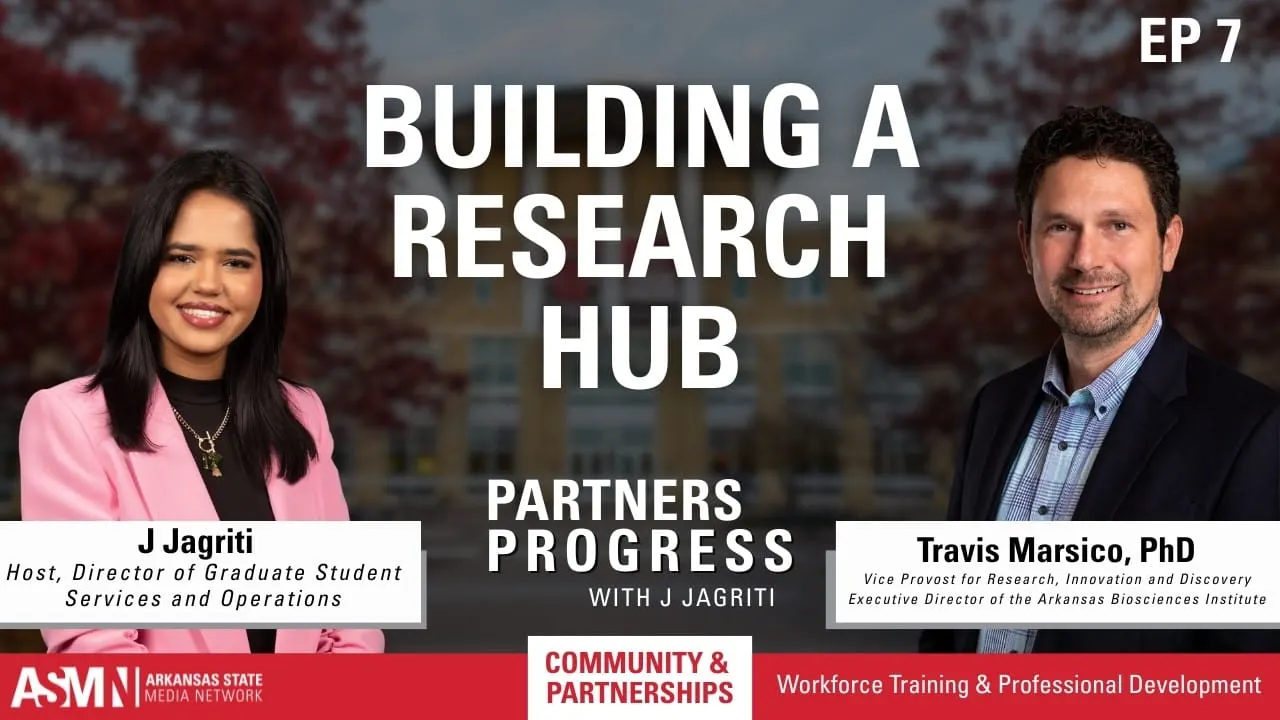
Stagnant funding limits institutional growth and stifles student potential. As academic budgets tighten across the board, scaling internal research operations is critical for long-term university survival and providing students with competitive, hands-on experience. Dr. Travis Marsico, Vice Provost for Research, Innovation, and Discovery at Arkansas State University, joins us to break down how his team successfully tripled research expenditures in just two years.
We sit down to unpack the exact mechanics of moving a university from $7.2 million to over $22 million in research funding. The conversation covers how to strategically allocate seed funds, navigate strict research compliance protocols, manage pre-award proposal development, and push innovations through the technology transfer pipeline. The driving force behind this massive growth relies heavily on getting the right people in the right seats on the bus, ultimately turning a historically quiet summer campus into a record-breaking grant submission machine.
Navigating federal grant rejections is brutal, and assembling a 100-page narrative with strict facility statements and collaborative documents demands immense operational stamina. Scaling this fast requires pushing through frequent failures without internalizing the rejection or sacrificing work-life balance. Listeners will walk away with a clear system for keeping staff motivated through heavy administrative friction, proving that empowering faculty to get back on the horse yields far better results than fostering a high-stress environment.
If you care about institutional growth, research commercialization, and cultivating a healthy team culture, you’ll get a lot from this. Please subscribe and share this episode with anyone looking to optimize their organization's operational output. What is the biggest hurdle your organization faces when trying to scale funding or foster interdisciplinary collaboration?
@Arkansasstatemedianetwork.com.
More About this Episode
Scaling Internal Research Operations to Triple University Funding
Stagnant funding limits institutional growth and actively stifles student potential in modern higher education. As academic budgets tighten across the board, finding new avenues for revenue is no longer a luxury. It is a strict necessity. Scaling internal research operations stands out as a critical strategy for long-term university survival and for providing students with the competitive, hands-on experience they need to succeed in the modern workforce. Transforming a traditional academic environment into a thriving hub of innovation requires a fundamental shift in strategy. It demands a complete reimagining of how universities approach research expenditures, team realignment, and faculty empowerment.
When institutions successfully implement these structural changes, the results can be staggering. An institution can genuinely take its research funding from a baseline of $7.2 million to an impressive $22 million in just two short years. This kind of explosive institutional growth does not happen by accident. It is the result of meticulous planning, strategic seed funding, and a relentless focus on optimizing operational output across all departments.
The Mechanics of Team Realignment
The driving force behind any massive growth initiative relies heavily on personnel. You can have the best strategic plan in the world, but if you lack the operational stamina to execute it, the plan will fail. Tripling research expenditures requires leadership to look closely at their organizational chart and make difficult decisions about team realignment. Getting the right people in the right seats on the bus is the foundational step toward building a sustainable research ecosystem. This means identifying individuals who not only understand the complex landscape of federal grants but who also possess the collaborative spirit necessary to foster interdisciplinary research.
When universities prioritize placing highly capable administrators and grant specialists in key roles, the entire culture shifts. Historically quiet summer campuses transform into record-breaking grant submission machines. The summer months, typically viewed as a time of academic rest, become prime real estate for deep, focused proposal development. Faculty members need support systems that remove administrative friction so they can focus on what they do best, which is discovering new knowledge and pushing the boundaries of their respective fields. By realigning the team to provide robust support, universities can dramatically increase their volume of grant submissions without burning out their core faculty members.
Navigating Pre-Award Proposal Development
Once the team is correctly positioned, the focus must shift to the grueling process of pre-award proposal development. Securing federal funding is an intricate dance of scientific vision and bureaucratic precision. Assembling a single grant application often requires drafting a 100-page narrative accompanied by strict facility statements, budget justifications, and highly detailed collaborative documents. This process demands immense operational stamina from both the faculty researchers and the administrative staff supporting them.
To scale funding at a rapid pace, universities must invest in specialized grant writing workshops and dedicated support personnel who can seamlessly navigate strict research compliance protocols. Compliance is not merely a bureaucratic hurdle to clear. It is a critical component of institutional integrity that safeguards the university and its researchers. When compliance protocols are integrated smoothly into the pre-award proposal development phase, the friction is minimized. Faculty members are far less likely to feel overwhelmed by the regulatory requirements if they have a dedicated team guiding them through the maze of federal demands.
Strategic allocation of seed funds also plays a vital role in this early stage. By providing faculty with small, targeted internal grants, universities empower them to gather the preliminary data necessary to make their federal grant applications substantially more competitive. This internal investment acts as a catalyst, sparking larger external returns and fueling the continuous cycle of institutional growth.
Pushing Innovations Through the Technology Transfer Pipeline
Generating research dollars is only one part of the equation. True institutional growth also relies on research commercialization and pushing innovations through the technology transfer pipeline. Universities are uniquely positioned to serve as economic engines for their local and regional communities. When faculty members make groundbreaking discoveries, those innovations must not languish in academic journals. They need a clear, supported path to the commercial market where they can have a tangible impact on society.
Developing robust technology transfer and innovation centers allows institutions to translate academic research into real-world solutions. This pipeline requires a completely different set of skills compared to traditional academic grant writing. It involves intellectual property management, navigating patent law, and negotiating complex industry partnerships. By fostering an environment where research commercialization is actively encouraged and financially supported, universities can create brand new revenue streams while simultaneously elevating their institutional profile on a national level.
This commitment to technology transfer also provides unparalleled opportunities for the student body. When students are actively involved in projects that move from the laboratory to the marketplace, they gain invaluable hands-on experience that sets them apart in an increasingly competitive job market. The technology transfer pipeline thus serves a highly beneficial dual purpose. It drives financial growth for the university and directly enhances the educational outcomes for its students.
Building Resilience and Navigating Federal Grant Rejections
Scaling internal research operations is not a path for the faint of heart. The reality of the academic funding landscape is that rejection is a constant, unavoidable companion. Navigating federal grant rejections is a brutal experience for everyone involved. After spending months assembling a massive proposal, receiving a denial can be deeply demoralizing for both the principal investigator and the administrative support staff. However, achieving massive growth in research expenditures requires building an unbreakable culture of resilience.
Scaling this fast requires pushing through frequent failures without internalizing the rejection or sacrificing work-life balance. Leadership must frame rejections not as final defeats, but as inevitable, informative steps in the iterative process of securing funding. When a proposal is rejected, the review panel provides feedback that can be used to strengthen the next submission. The key to maintaining operational stamina is ensuring that staff and faculty remain motivated through heavy administrative friction. Empowering faculty to get back on the horse yields far better results than fostering a high-stress, punitive environment where mistakes are punished.
Universities must proactively prioritize a healthy team culture where work-life balance is respected and protected. Grant writing is a marathon, not a sprint. If the institutional culture demands constant overtime and ignores the emotional toll of grant rejections, the most talented researchers and administrators will eventually leave for healthier environments. By providing emotional support, recognizing the immense effort regardless of the final outcome, and offering constructive debriefing sessions, leaders can maintain a motivated and resilient workforce capable of weathering the turbulent storms of the federal funding cycle.
Fostering Interdisciplinary Collaboration for the Future
As we look to the future of academic research, it is abundantly clear that the most pressing global challenges cannot be solved within the isolated silos of individual academic departments. Climate change, public health crises, and rapid technological advancements require a multifaceted approach. Fostering interdisciplinary collaboration is therefore absolutely essential for universities that want to remain competitive in the pursuit of major federal funding initiatives. Granting agencies are increasingly prioritizing and funding projects that bring together experts from diverse fields to tackle complex, systemic problems.
Creating a true culture of interdisciplinary research requires intentional, sustained effort from university leadership. Universities must actively break down the traditional administrative and financial barriers that prevent different departments from working together seamlessly. This might involve restructuring exactly how grant funds and indirect costs are distributed internally, or creating shared laboratory spaces that encourage spontaneous, collaborative interactions between researchers from completely different disciplines. When universities actively promote and facilitate interdisciplinary collaboration, they unlock new levels of creativity and innovation. This collaborative approach not only strengthens the scientific merit of grant proposals but also enriches the entire academic environment, providing students with a much broader, more holistic perspective on complex problem-solving.
The Long-Term Impact on Institutional Growth and Student Potential
The ultimate goal of scaling internal research operations and tripling research expenditures is not merely to accumulate wealth or prestige for the institution. The true, underlying purpose is to fuel long-term institutional growth that directly benefits the student body and the broader surrounding community. When universities invest heavily in their internal research infrastructure, they create a vibrant intellectual ecosystem that naturally attracts top-tier faculty and highly motivated, ambitious students.
Increased research funding allows institutions to radically upgrade their physical facilities, purchase cutting-edge laboratory equipment, and offer significantly more scholarships and graduate assistantships. These structural investments directly and immediately impact student potential. Students who have the unique opportunity to engage in funded research projects receive a level of mentorship and practical training that simply cannot be replicated in a traditional lecture hall setting. They learn exactly how to formulate hypotheses, design rigorous experiments, analyze complex sets of data, and communicate their findings to a broader audience. These are the exact critical thinking and analytical skills that top employers demand in today's fast-paced, knowledge-based economy.
By focusing entirely on the strategic expansion of research capabilities, universities secure their own financial future while simultaneously fulfilling their fundamental mission of educating the next generation of global leaders. The journey from a stagnant operating budget to a thriving, multi-million dollar research portfolio is incredibly challenging, but the blueprint for success is clear. It requires strategic, calculated investments in personnel, a highly streamlined approach to pre-award proposal development, a robust and active technology transfer pipeline, and a resilient team culture that wholeheartedly embraces interdisciplinary collaboration.
Overcoming the hurdles of stagnant funding is a monumental task, but it is entirely possible with the right operational strategies firmly in place. By realigning teams, investing in pre-award support, and cultivating a culture that views rejection as a necessary stepping stone rather than an insurmountable roadblock, institutions can dramatically increase their research funding footprint. Scaling internal research operations is the absolute most effective way to ensure university survival in an era of tightening academic budgets. It requires bold vision, immense operational stamina, and a steadfast commitment to empowering the people who drive the research engine forward every single day. When an institution fully commits to these core principles, it not only transforms its own financial trajectory but also profoundly enhances the educational experience for its students, ultimately shaping a much brighter, more innovative future for the entire academic community.