
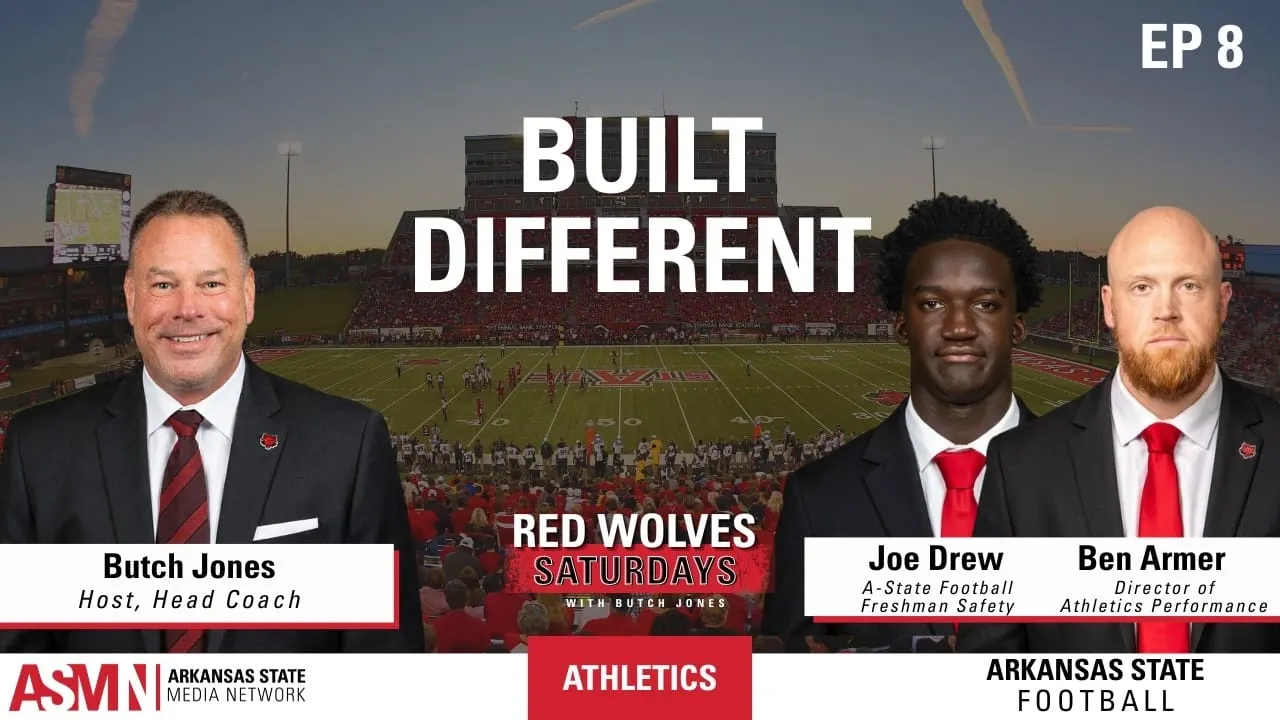
Winning games in November happens in January, far away from the Saturday lights. With pre-training camp in full swing, summer physical transformations and cultural alignment dictate the trajectory of the upcoming season. In this edition of Red Wolf Saturdays, Head Coach Butch Jones sits down with Director of Strength & Conditioning Ben Armer and starting linebacker Joe Drew to break down the physical and mental prep driving Arkansas State.
We sit down to break down the mechanics of roster development in modern college football. Highlights include moving an athlete from nickel cornerback to middle linebacker, managing caloric intake to pack on 20 pounds of lean mass, and integrating sports science with sprint mechanics. Coach Armor shares his core philosophy that strength staffs control nearly 87% of an athlete's calendar year, meaning daily micro-habits, not short-term motivation, determine fourth-quarter execution.
Putting on functional mass while maintaining top-end speed in 100-degree summer heat requires unrelenting discipline. Players face the physical strain of heavy winter lifting cycles, constant nutrition tracking, and early morning accountability standards where bad days simply aren't tolerated. Viewers will walk away with an insider look at how coaching staffs construct physical durability and install a high-standard culture from the weight room outward.
If you care about college football development, strength and conditioning protocols, and building a winning team culture, you’ll get a lot from this. Be sure to subscribe to the channel and share this episode with fellow football fans. What is the biggest physical or position transition you've seen a player successfully pull off on the field? Let us know in the comments below.
More About this Episode
The Blueprint of College Football Player Development: Inside the Science of Strength and Conditioning
The pageantry of college football is celebrated on Saturdays in the fall, but the actual foundation of a winning program is poured in the freezing mornings of January and the sweltering heat of July. If you want to understand the lifeblood of college football player development, you have to look through a very specific lens. You must examine the strength and conditioning area. This domain serves as the heartbeat of any athletic department, blending the overarching vision of a head coach with the everyday, ground level grit of the players putting in the work. Building a championship caliber college football program requires a year round commitment that transforms raw talent into finely tuned, highly capable athletes ready for the grueling demands of a competitive season.
The journey of a collegiate sports performance coach is not for the faint of heart. It is a profession built entirely on passion and relentless dedication. The hours required in coaching are incredibly demanding, and you find out very quickly if you have a true passion for this line of work. The path often begins with unpaid internships, grinding away in the early hours of the morning just to get a foot in the door. Teaching high school kids how to train is frequently the best foundational experience a young coach can have. If you can motivate a fourteen to seventeen year old to execute a flawless power clean with perfect mechanics, you can teach anybody how to train. From those grassroots beginnings, coaches have the opportunity to learn from the greatest minds in the profession, absorbing knowledge from first generation strength coaches who helped win Super Bowls and NBA Championships. Working with a wide variety of athletes, including Olympic sports, female athletes, and overhead athletes, molds a well rounded sports performance director who is prepared to lead a massive collegiate football roster.
In the modern era of college football, the integration of sports science has revolutionized how we approach player development. We have transitioned from the old school methods of simply lifting heavy weights to a highly analytical, data driven approach. The utilization of advanced technology allows coaches to track performance metrics, predict physical outcomes, and implement strategies that translate directly to on field success. However, even with all of this incredible technology at our fingertips, the fundamental requirement remains completely unchanged. You have to understand the culture of the locker room.
When a new strength coach steps into a program, they are an extension of the head coach and the overarching vision for the team. The hardest part of the job is usually establishing trust and building a foundation. But when a locker room already possesses a strong culture, the job becomes significantly more focused. Coaches can immediately identify the established leaders who know the expectations inside and out. With a culture of accountability already laid out on a silver platter, the staff can dive straight into the physical transformations. The art and science of strength and conditioning is a beautiful dynamic. The art is taking all the intangible qualities required to make a strong football team last into the fourth quarter without getting complacent. The science is making them stronger, more powerful, and incredibly well conditioned along the way.
To truly understand player development, you have to look closely at the athletes navigating these off season programs. A journey can start in the most unexpected places. Imagine a high school athlete who spends his underclassman years running cross country instead of playing football. Then, driven by sheer curiosity and a coaching change, he steps onto the gridiron as a junior. He plays corner, catches passes, and makes tackles all over the field, completely unaware of the massive collegiate potential he possesses. After arriving on a campus for an unofficial, bare bones visit, the authenticity of the coaching staff sparks a commitment. This is the reality for many young players who rely strictly on an unyielding work ethic. When you do not compare yourself to others and simply put your head down to work, you can emerge from the bottom of the depth chart to become a vital piece of a championship puzzle.
Making a position change in college football is one of the most mentally and physically taxing challenges an athlete can face. Moving from a perimeter position, like nickel or outside linebacker, to the interior of the defense requires a complete rewiring of a player's instincts. When you play outside the box, you rely heavily on space and speed. You are essentially playing two yards away from being a traditional linebacker. But when you move inside the box, the entire game shifts. You are suddenly operating in a phone booth. You are no longer just covering agile receivers in open space. You are taking on three hundred pound offensive linemen who are coming downhill with bad intentions.
The biggest part of this transition is the mental processing. You have to understand the intricacies of the scheme so thoroughly that you go from taking directions to giving them. Once you master the mental side of the defense, the physical reactions simply become instincts. You transition to a mentality of seeing the ball and getting the ball. We have seen this exact progression in the National Football League with players like Jaylen Reeves Maybin, who transitioned from an undersized high school quarterback and safety into a highly successful professional linebacker. The formula is always the same. It requires an instinctual drive to find the football and a willingness to excel on special teams before making a mark on the starting defense.
Let us talk about the physical transformation required for such a monumental move. Going from one hundred and ninety pounds to over two hundred and seven pounds in a matter of a few short months is a massive undertaking. It requires a diligent, daily process that goes far beyond the walls of the weight room. In the winter months, the primary focus of the sports performance staff is building size and foundational strength. You cannot try to be a jack of all trades during this phase, otherwise, you risk becoming mediocre at everything. Building raw strength takes absolute priority because it sets the table for the intense running and speed development that follows in the summer.
Achieving this type of lean muscle mass requires extreme discipline in nutrition. Players must attack their diets with the exact same intensity they bring to the squat rack. It is not uncommon for players to consistently reach out to their coaches on weekends to show them the meals they are consuming. Sometimes, that means frequenting the local Waffle House for an All Star special with bacon, eggs, cheese melts, and a bowl of grits just to hit the immense caloric intake required. When the summer months arrive and the temperatures soar into the nineties and hundreds, the physical demands multiply. Players are burning far more calories running in the sweltering heat than they ever did lifting in the winter. They have to constantly adjust their fueling strategies to maintain the weight they worked so hard to put on. The players who are in the driver's seat of their own development are the ones who refuse to have a bad day. In this modern era of college football, that level of consistency is rare and deserves immense credit.
I want to take a moment to reflect on a specific statistic that highlights the profound impact of the strength and conditioning staff. Several years ago, a comprehensive study was conducted to determine exactly how much time college football players spend with their sports performance coaches compared to their on field coaching staff. The results were staggering. Eighty seven percent of the calendar year is spent strictly under the guidance of the strength and conditioning department. We only get twelve guaranteed opportunities to play the game on Saturdays during the fall. The rest of the year is dedicated to preparation. This is what makes football the greatest team sport in existence. The amount of unseen hours spent preparing far outweighs the time spent actually playing the game. It is incredibly rewarding for a strength staff to watch a team execute a vision they have been building tirelessly for eight months.
As we transition from the weight room to the practice field, speed and conditioning become the final pieces of the puzzle. We break down the absolute finest details of movement. We study the sprint mechanics of legendary Olympic athletes like Usain Bolt to understand how to maximize efficiency and explosion. This applies to every single player on the roster, from the massive defensive linemen to the safeties patrolling the deep third of the field. The goal is to build a team that plays incredibly fast. When a defense is playing fast and executing their assignments perfectly, it is a nightmare for opposing offenses to handle. We want a defense that is vicious and ruthless. You want opponents to feel your physical presence and fear your speed before the first snap even happens.
Establishing this level of dominance requires an unyielding command presence from the coaching staff. We often compare our sports performance directors to drill sergeants because they bring an intense, undeniable energy every single morning, regardless of how early the sun rises. The players feed off this energy. When the staff brings that level of passion, the team has no choice but to match it. Furthermore, the standard is driven by an obsession with details. It is not just about what you do in the weight room, it is about how you do it. You can throw three hundred and fifty pounds on a bar for a power clean, but if your fundamentals are flawed and your steps are incorrect, you will be heavily critiqued. Perfecting the small movements is what leads to explosive gains on the field.
Ultimately, the goal of an off season program is to build a recognizable identity. When fans come out to watch this team play, they are going to see a group of young men who have fully committed to a rigorous standard of excellence. They have grown together, adapted to new coaching philosophies, and elevated their practice habits to a completely new tier. The way this team moves, the way they orchestrate their practices, and the way they carry themselves in the community is a direct result of the work put in during the off season. We are incredibly proud of the accountability and leadership demonstrated by our players. The foundation has been poured, the strength has been built, and the speed has been refined. Now, it is time to let the results speak for themselves on the field.