
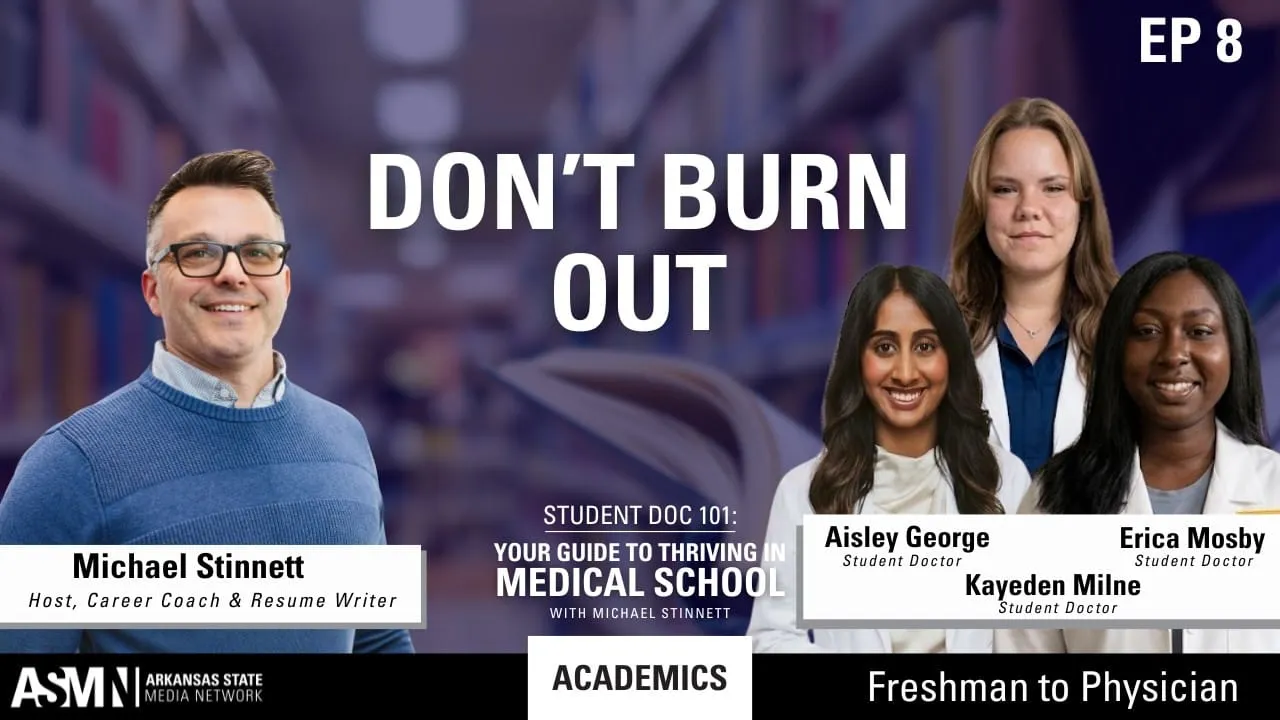
The transition from undergrad to medical school can feel like drinking from a firehose, and most students quickly realize that brute-force memorization isn't enough to survive. With high-stakes exams and massive workloads, understanding how to manage your time and protect your cognitive performance is crucial for any incoming student. In this episode of Student Doc 101, NYITCOM learning specialist Michael Stinette sits down with student doctors Erica Mosby, Kayeden Milne, and Aisley George to unpack what it really takes to thrive in medical school without losing your mind.
We get into the tactical adjustments required to conquer the medical school learning curve, from ditching popular study tools like Sketchy or Anki when they don't fit your learning style, to leveraging real-life scenarios and whiteboard dumping for complex medical concepts. The student doctors list actionable test-taking strategies, like why you should never change your first answer on an exam, and explain the importance of a tiered, scaffolding approach to question banks like ScholarRX and TrueLearn. The secret sauce to their success lies in embracing variability: recognizing that you don't have to study at 8:00 AM just because your peers do, as long as you hit your daily goals.
Behind the white coats and prestige lies a daily struggle with imposter syndrome, fight-or-flight stress responses, and the temptation to sacrifice sleep, proper diet, and exercise just to squeeze in one more hour of studying. The student doctors share their experiences with mental clutter and the danger of "over-resourcing," warning incoming students against blindly following standard schedules that lead to burnout. You will walk away with a practical mindset shift on how to establish non-negotiable self-care routines, use peer accountability to protect your personal time, and give yourself the grace needed to navigate the hardest years of your academic career.
If you care about medical school time management, efficient study hacks, and maintaining your mental health during grueling academic programs, you will get a lot from this. Don't forget to subscribe to the channel and share this episode with a fellow med student or anyone preparing for the journey ahead. What is the one self-care habit or "non-negotiable" you refuse to sacrifice during a busy work or study week? Let us know in the comments below!
@Arkansasstatemedianetwork.com.
More About the Episode
Mastering the Medical School Learning Curve: Time Management, Tactical Study Habits, and Cognitive Longevity
The transition from undergraduate studies to medical school is one of the most intense academic jumps a student will ever experience. Often described as drinking from a firehose, the sheer volume of information can quickly overwhelm even the most accomplished students. Many incoming medical students rely on the brute-force memorization techniques that served them well in college, only to realize within the first few weeks that rote memorization is simply not sustainable. Succeeding in medical school requires a fundamental shift in how you approach learning, time management, and personal health.
To thrive in a grueling academic program without losing your mind, you must stop viewing medical school as a test of endurance and start treating it as an exercise in cognitive performance. By implementing strategic study habits, avoiding common traps like resource overload, and establishing non-negotiable self-care routines, you can conquer the curriculum while protecting your mental health.
The Reality Check: Confronting the Learning Curve
The first step in mastering the medical school learning curve is accepting that the volume and velocity of the material are unlike anything you have faced before. In undergraduate science courses, you might have had weeks to digest a single metabolic pathway or physiological concept. In medical school, that same amount of information is often covered in a single morning lecture.
This rapid pace frequently triggers a fight-or-flight stress response among incoming students. When faced with high-stakes exams and massive workloads, it is entirely normal to feel a sudden loss of control. This stress is often compounded by imposter syndrome: the persistent feeling that you do not belong among your high-achieving peers. When you sit in a lecture hall surrounded by brilliant minds, it is easy to assume that everyone else is grasping the material effortlessly while you are struggling just to keep your head above water.
In reality, almost every medical student wrestles with imposter syndrome and academic anxiety behind their white coat. Acknowledging this reality is crucial. When you realize that the struggle is universal, you can stop wasting mental energy on self-doubt and channel your focus into refining your daily study systems.
Avoiding the Resource Overload Trap
One of the most dangerous pitfalls for first-year medical students is resource overload. When faced with an overwhelming amount of medical knowledge, students often panic and try to use every available resource on the market. They subscribe to multiple video platforms, download massive flashcard decks, purchase supplementary textbooks, and attempt to follow standard schedules recommended by older peers.
This scattershot approach creates severe mental clutter and almost always leads to burnout. While popular study tools like Anki and Sketchy have helped thousands of students succeed, they are not universally effective for everyone. If visual mnemonics or spaced-rehearsal flashcards do not align with your personal learning style, forcing yourself to use them simply because your classmates do is a waste of valuable time.
Efficiency in medical school comes from streamlining your study stack. Successful students identify two or three primary learning tools that resonate with how their brain processes information, and they ignore the rest. If you learn best by drawing out diagrams or reading clinical case studies, give yourself the permission to ditch trendy study tools that feel like a chore. True academic efficiency is about mastery of the material, not the number of resources you can check off a to-do list.
Tactical Study Habits That Actually Build Retention
Once you have stripped away the excess noise and narrowed down your resources, you must focus on active learning strategies that promote long-term retention. Passive study habits like re-reading lecture slides, highlighting textbooks, or re-watching recorded lectures at double speed create a false sense of familiarity without actually building pathways for memory retrieval. To perform well on board exams and clinical rotations, you need tactical study habits that challenge your brain to produce information on demand.
Active Recall Through Whiteboard Dumping
One of the most powerful techniques for mastering complex physiological processes and anatomical structures is whiteboard dumping. Instead of passively looking at a metabolic chart or a wiring diagram of the nervous system, close your book, stand in front of a blank whiteboard, and draw out the entire system from memory.
When you force yourself to sketch a pathway without visual prompts, you immediately expose the gaps in your understanding. You will quickly discover which steps of a cascade you truly know and which ones you were simply recognizing on the page. Once you have written down everything you can remember, step back and use your textbook or lecture notes to fill in the missing pieces in a different color. Repeating this process until you can reproduce the entire diagram from memory builds robust neural connections that hold up under exam pressure.
Leveraging Real-Life Clinical Scenarios
Basic science concepts can feel abstract and dry when studied in a vacuum. To make foundational material stick, anchor dry scientific facts to real-life clinical scenarios. Whenever you are studying a biochemical enzyme or an anatomical structure, ask yourself a simple question: what happens to a patient when this specific mechanism fails?
Connecting a cellular pathway to a tangible patient presentation transforms abstract memorization into clinical reasoning. When you understand the pathophysiology behind a patient's symptoms, the underlying basic science becomes intuitive. This approach not only helps you perform better on written exams, but it also prepares you for the clinical decision-making you will use on hospital wards.
A Scaffolding Approach to Question Banks
Many students make the mistake of saving practice question banks until the final weeks before an exam. High-performing students use question banks as active learning tools from day one. Integrating platforms like ScholarRX and TrueLearn into your weekly routine requires a tiered, scaffolding approach.
In the early stages of learning a new organ system, use question banks in untimed, tutor mode to reinforce foundational concepts. Treat every question as a mini-lesson: read the comprehensive explanations for both the correct answer and all the incorrect distractors. As exam day approaches, transition your question bank usage to timed, randomized test mode. This phased strategy builds your test-taking endurance and exposes you to the various ways examiners frame clinical vignettes.
Mastering Test-Taking Psychology
Scoring well on medical school exams requires more than just content knowledge; it requires test-taking discipline. Under the intense pressure of a timed exam, anxiety often tempts students to second-guess their intuition and change their answers.
As a general rule of test-taking psychology, you should almost never change your first answer unless you have identified a concrete, undeniable misreading of the question stem. Your initial instinct is usually guided by subconscious pattern recognition built through hundreds of hours of studying and practice questions. When you start second-guessing yourself out of panic, you are far more likely to change a correct answer to an incorrect one. Trust the preparation you put in before stepping into the testing center.
The Secret to Sustainable Productivity: Embracing Variability
There is a pervasive myth in medical education that successful students must follow a rigid, militaristic schedule: waking up at 5:00 AM, studying for eight uninterrupted hours in the library, and maintaining the exact same routine seven days a week. Trying to conform to an arbitrary timetable that conflicts with your natural circadian rhythm is a guaranteed recipe for fatigue.
The secret to sustainable productivity lies in embracing variability. You do not have to study at 8:00 AM just because your peers are in the library. If you are someone who hits your cognitive peak late in the afternoon or evening, design your schedule around your natural focus windows.
What matters most in medical school is not the exact hours of the day you sit at your desk, but whether you consistently hit your daily learning goals. Build flexibility into your weekly calendar so you can adjust your study hours based on your energy levels and the difficulty of the current module. By shifting your focus from hours logged to tasks completed, you can maintain a high level of academic output without feeling trapped by a rigid routine.
Protecting Your Non-Negotiables: Self-Care for Cognitive Performance
When exams loom and stress levels spike, students often feel tempted to sacrifice sleep, proper nutrition, and exercise just to squeeze in one more hour of studying. This is one of the most destructive trades you can make in medical school. Treating your body poorly directly impairs the cognitive functions you need to succeed: working memory, concentration, information consolidation, and emotional regulation.
Why Sleep is an Academic Tool
Sleep is not a luxury that you earn after studying; it is an active, essential biological process required for learning. During deep sleep and REM cycles, your brain consolidates the facts, concepts, and pathways you spent the day reviewing, transferring them from short-term working memory into long-term storage. When you pull all-nighters or chronically restrict your sleep to five hours a night, you effectively erase a significant portion of the studying you did during the day. Protecting a consistent seven to eight hours of sleep every night is the single best investment you can make in your exam scores.
Establishing Non-Negotiable Self-Care Routines
To maintain peak cognitive performance across a four-year medical program, you must establish non-negotiable self-care habits. Think of your physical health, your nutrition, and your mental well-being as foundational pillars that support your academic success. If those pillars collapse, your grades will inevitably follow.
Identify specific habits that anchor your week and treat them with the same respect you give to mandatory hospital rotations. Whether your non-negotiable habit is a thirty-minute weightlifting session, a daily outdoor walk without your phone, a weekly meal-prep afternoon, or a Friday evening dinner with friends or family, lock it into your schedule. Do not allow academic anxiety to encroach on these protected hours.
Leveraging Peer Accountability
Staying committed to self-care can be difficult when you are isolated in your studies. Leveraging peer accountability is a highly effective way to protect your personal time. Find a classmate or a study group that shares your commitment to work-life balance.
Use your peers not just for academic quizzing, but to hold each other accountable to healthy habits. Make agreements to leave the library at a reasonable hour, train together at the gym, or take regular breaks to step outside and disconnect from medical jargon. When you surround yourself with colleagues who prioritize cognitive longevity over chronic overworking, it becomes much easier to maintain your own healthy boundaries.
Giving Yourself the Grace to Grow
Navigating medical school is a marathon that tests your resilience, adaptability, and dedication. There will be weeks when an exam does not go as well as you hoped, times when a complex topic refuses to click, and moments when the sheer weight of the journey feels overwhelming. During those times, the most important skill you can practice is giving yourself grace.
Perfectionism is a liability in medical training. You do not need to score perfectly on every assessment or know every esoteric medical fact to become an exceptional, compassionate physician. Growth in medicine comes from learning through your mistakes, continuously refining your study strategies, and having the courage to ask for help when you need it.
By trusting your unique learning style, protecting your non-negotiables, and treating yourself with compassion, you can successfully navigate the hardest years of your academic career. When you step back and view medical school as a transformative journey of professional growth rather than a daily fight for survival, you will not only become a better student, but you will also become a healthier, more empathetic doctor.