
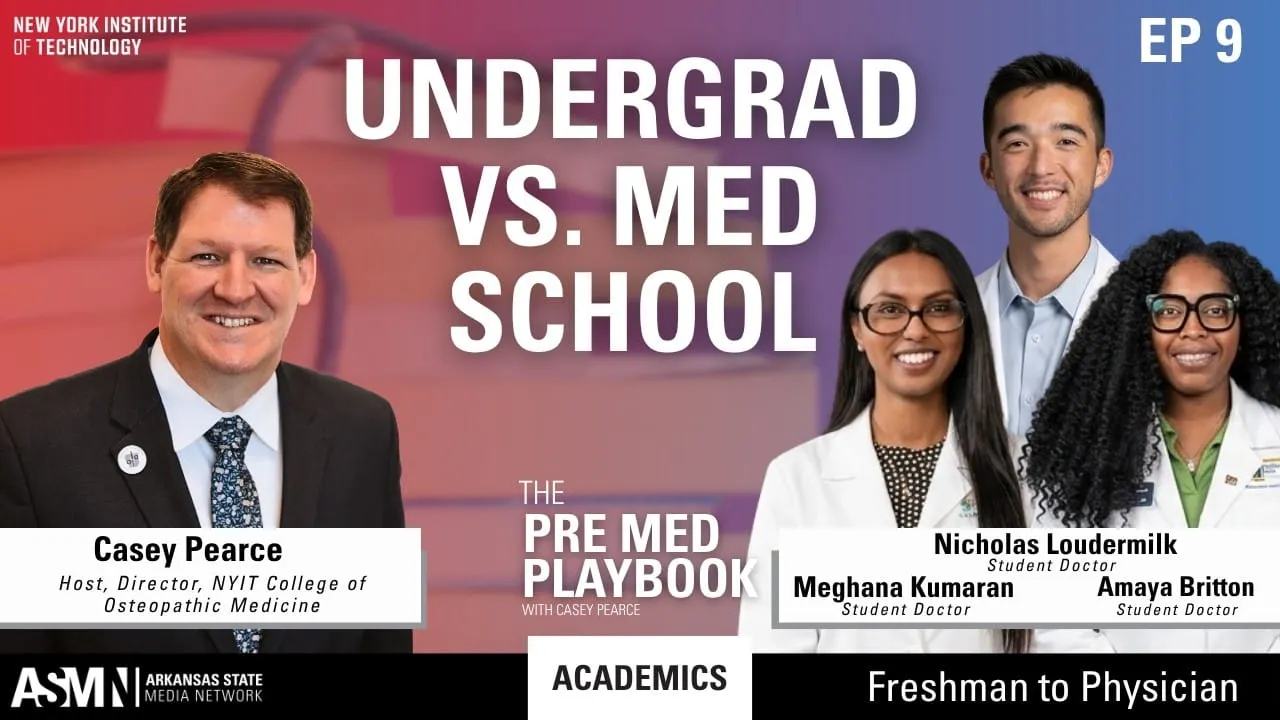
Burnout is a silent career killer for first-year medical students. With orientation season wrapping up and the academic pressure cooker officially turning on, aspiring physicians need to know exactly what they are walking into before the workload becomes unmanageable. Casey Pearce sits down with veteran NYITCOM students Meghana Kumaran, Amaya Britton, and Nicholas Loudermilk to unpack the intense realities and practical strategies for surviving the transition into medical school.
We get into the tactical shifts required to handle the massive academic load. The discussion covers the necessity of managing asynchronous lectures, building effective study schedules, and properly executing multiple study passes rather than jumping straight into practice questions. The group also shares a unique pancake metaphor that perfectly illustrates why daily consistency is the absolute secret to enduring the relentless pace of medical education.
The reality of medical school means accepting that you will be drinking from a firehose, jumping from a standard undergraduate pace to processing roughly 55 lectures in a single month. This volume forces a massive shift in priorities, requiring students to learn how to balance intense study schedules with maintaining physical health, personal relationships, and their own sanity. The main takeaway is the realization that you have to drop the lone-wolf mentality, ask for help early, and be completely willing to pivot your study routines when your current methods fail.
If you care about optimizing your study habits, protecting your mental bandwidth, and understanding the true demands of a medical education, you will get a lot from this conversation. Please subscribe to the channel and share this episode with any aspiring physicians in your network. What is the biggest study habit you are ready to pivot right now?
@Arkansasstatemedianetwork.com
More About this Episode
Surviving Your First Year of Medical School: Essential Advice for Incoming Students
If you are an aspiring physician or an incoming first year student, you are likely preparing yourself for one of the most rigorous academic journeys imaginable. Here at NYIT College of Osteopathic Medicine at Arkansas State University, we see hundreds of incredibly bright, high achieving individuals step onto our campus every year. They arrive with stellar undergraduate transcripts, a passion for medicine, and a deep desire to help others. Yet, almost universally, these new medical students are hit with a profound realization during their first few weeks. The medical school experience is vastly different from anything they have ever faced before.
The material is deeper, the pace is faster, and the environment is filled with peers who are just as academically gifted as you are. Understanding how to navigate this massive transition is the key to not just surviving your first year of medical school, but truly thriving. Based on insights from veteran students who have successfully navigated this challenging terrain and now help guide our orientation process, we have compiled the most crucial strategies for conquering your first year.
Understanding the Monumental Shift from Undergraduate Studies
Every student who gains acceptance into a medical program has a history of academic excellence. You do not reach this point without knowing how to study, pass exams, and manage your time in a traditional college environment. However, what works in an undergraduate setting rarely translates perfectly to medical school.
To quantify this difference, consider the sheer volume of information. In a typical undergraduate science course, you might cover fifty five lectures over the span of an entire six month semester. In medical school, you are likely to face those same fifty five lectures in a single month. The content itself is certainly challenging, but it is the velocity at which the material is delivered that creates the steepest learning curve. The commonly used analogy of "drinking from a firehose" is incredibly accurate. You are hit with an unrelenting stream of complex data week after week.
Furthermore, your priority list must fundamentally shift. Many students come from backgrounds where they balanced demanding majors with collegiate sports, extensive social lives, or part time jobs. While maintaining a life outside of medicine is crucial for your mental health, your primary occupation in medical school is learning how to be a physician. The extracurricular activities that once took up hours of your day will need to be carefully managed or temporarily sidelined as you learn to balance this intense new workload.
Mastering the Asynchronous Lecture Format
Many modern medical programs utilize an asynchronous learning model for their didactic coursework. This means that instead of sitting in a lecture hall from dawn until dusk, lectures are pre recorded and provided to students at the beginning of the week. This self paced format offers incredible flexibility, but it also demands a supreme level of self discipline and time management.
Because you have the freedom to choose when you watch your lectures, every student develops a unique approach to their weekly schedule. Some choose to aggressively front load their week. By starting their lectures the moment they become available, they can finish all their primary viewing before the weekend arrives. This strategy allows the weekend to be utilized for secondary reviews, practice questions, and much needed rest.
Others prefer a completely different rhythm. Some students use their weekends to casually watch the upcoming week's lectures, getting a broad overview of the material without the stress of deep memorization. This allows them to use their Monday through Friday strictly for intensive, deep dive studying. Neither method is inherently better than the other. The secret is finding the rhythm that aligns with your personal energy levels and learning style.
Developing and Pivoting Your Study Habits
One of the most frequent questions incoming medical students ask is simply how to study. It is a loaded question because there is no single correct answer. You can ask nine different highly successful medical students about their study routines and you will likely receive nine completely different answers.
Your first semester is largely about experimentation. You will be introduced to a mountain of third party resources, from BootCamp to specialized flashcard applications like Anki. The key to finding your ideal study habit requires balancing patience with adaptability.
First, you must give a new resource or method enough time to actually work. Trying a new study technique for two days is not enough time to gauge its effectiveness. You need to commit to a method for a week or two to see if the knowledge is truly clicking.
However, you must also master the art of the pivot. A great motto for medical students to adopt is to remain committed to the goal but not stuck to the method. If you spend two weeks on a specific resource and your practice scores are not improving, you must possess the humility and flexibility to abandon that method and try something else. Finding your study habits is often cited as the hardest part of medical school. It requires a willingness to fail, learn from that failure, and immediately try a new approach.
The Concept of "Passes"
When veteran students talk about studying, they frequently refer to doing "passes" of the material. A pass is simply a review of the content, but each pass should look slightly different.
- First Pass: Watching the lecture to understand the big picture concepts.
- Second Pass: Creating or reviewing flashcards to lock in rote memorization.
- Third Pass: Utilizing outside resources to clarify difficult physiological concepts.
- Fourth Pass: Completing practice questions to test your application of the knowledge.
A common pitfall for first year students is jumping into practice questions too early. If you test yourself before you have a foundational grasp of the material, you risk destroying your confidence. Spend adequate time on the front end truly learning the mechanisms and concepts before you ask yourself to solve complex clinical vignettes.
The Pancake Philosophy: Consistency Over Cramming
Medical school is an endurance event, not a sprint. A professor once shared a brilliant metaphor during our orientation week that perfectly encapsulates the daily reality of medical education. Imagine that studying in medical school is like being required to eat ten pancakes every single day. If you sit down and eat your ten pancakes today, you will be fine. But if you decide to take a day off and eat zero pancakes, tomorrow you will be faced with twenty pancakes.
This metaphor highlights the absolute necessity of consistency. You cannot cram for medical school exams the way you might have in your undergraduate years. The sheer volume of material makes it physically impossible to catch up if you fall too far behind. By staying consistent and tackling your daily tasks, you prevent the material from piling up into an unmanageable mountain.
Staying consistent is also the primary way you carve out time for positivity and rest. Once you establish a solid, reliable schedule, you can easily identify the pockets of free time in your week. You can use those pockets to exercise, call your family, or simply relax. Knowing that you have handled your daily academic responsibilities allows you to enjoy your breaks without the crushing guilt of feeling like you should be studying.
The Essential Role of Community and Connection
It is incredibly easy to adopt a lone wolf mentality in academia. Many students achieve excellent undergraduate grades by isolating themselves in a library and relying solely on their own intellect. While this independence is an admirable trait, it is a dangerous strategy for medical school. Attempting to navigate this journey entirely on your own is a fast track to severe burnout.
Finding your community is just as important as finding your study habits. This is especially true for students who have relocated across the country and are far away from their traditional support networks.
A strong community serves two critical purposes. First, study groups can keep you accountable. Surrounding yourself with peers who are dedicated and focused can naturally elevate your own work ethic. Second, and perhaps more importantly, your community reminds you that you are a human being, not just a brain absorbing medical facts.
After a grueling study day or a difficult exam, you need people you can laugh with. You need friends to grab dinner with, go bowling with, or join you for a workout. Stepping away from the material to engage in normal, everyday activities with people who understand exactly what you are going through is vital for maintaining your mental health.
Crucial Advice for the Road Ahead
As you step into your first year of medical school, keep these final pieces of advice in mind.
Ask for help early and often. Do not wait until you are six weeks into a complex anatomy course and failing your quizzes to admit that you are struggling. Medical schools employ academic specialists, faculty members, and veteran student mentors who are completely dedicated to your success. Everyone wants to see you thrive, but they cannot help you if you hide your struggles. Ask for help the moment you feel yourself falling behind.
Give yourself grace and be patient. You are adapting to a new city, a new peer group, and a fundamentally new way of learning. You will not have a perfect schedule on day one. You will likely experience academic setbacks. Remind yourself daily that you earned your seat in this program. The admissions committee chose you because you have the intellect and the resilience required to become a physician.
Trust the process. There will be moments when you sit at your desk, stare at a seemingly endless list of biochemical pathways, and wonder if you can actually do this. You will hit a wall. When that happens, take a breath, rely on your consistent daily schedule, and trust the process. If you put in the daily work and do the best you can with the hours you have, you will be prepared when exam day arrives.
Medical school is profoundly challenging, but it is also filled with profound purpose. Accept that the road will be difficult, but embrace the fact that every hour of studying is bringing you one step closer to a deeply rewarding career in medicine. Stay consistent, lean on your community, and remember to take it one day, and one pancake, at a time.