
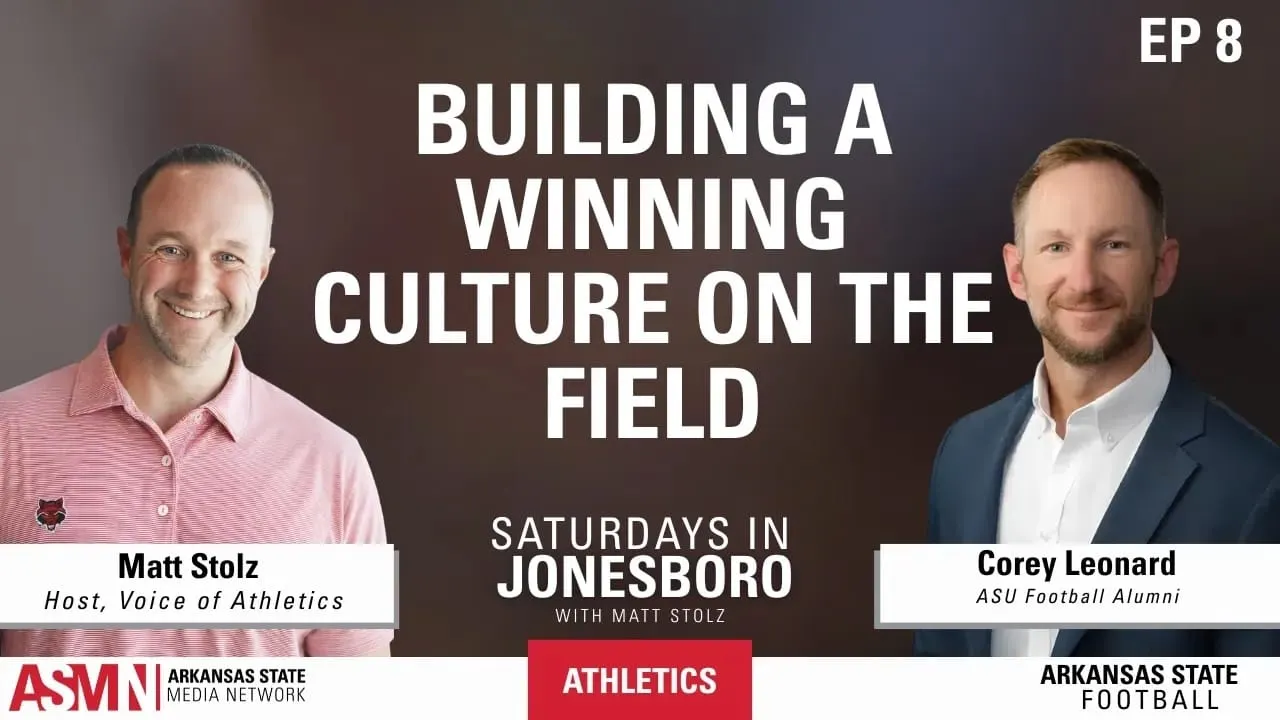
Rebuilding a college football program from decades of tough sledding to sustained respectability does not happen overnight. It requires a foundational culture shift, gritty leadership under pressure, and players willing to lay the groundwork long before the championship trophies arrive. With the 20th anniversary of one of the most iconic plays in Sun Belt Conference history approaching and A-State preparing to open the season at Memphis, there has never been a better time to examine how the Red Wolves built their winning identity. Former starting quarterback and 2022 Hall of Honor inductee Corey Leonard joins the show to break down his transition from being the last quarterback for the Indians to the first for the Red Wolves, while sharing what it took to put Arkansas State on the map.
We get into the raw X's and O's and the emotional highs behind some of the most unforgettable games in Arkansas State history. Corey walks us through the 2006 Army home opener, the chaotic physics of throwing a 70-yard Hail Mary to beat Memphis, silencing Kyle Field against Texas A&M in 2008, and pulling off a massive 31-6 halftime comeback against Memphis in 2007. Along the way, he highlights the impact of teammates like Tyrell Johnson, Patrick Higgins, and Levi Dejohnette. Corey also points to the unique coaching philosophy of Steve Roberts as the secret sauce behind their success, explaining how strict accountability and genuine care for players as men built the unity required to compete with college football's giants.
We also tackle the harder, grittier realities of a college football career, from intense quarterback battles in fall camp to the sting of mid-season adversity. Corey opens up about the emotional toll of his senior season injuries and the maturity it took to step aside and mentor a young Ryan Aplin in South Florida while the stadium was chanting for a change. You will walk away from this conversation with a powerful lesson on selflessness, locker room leadership, and why a program must work every single week to earn the respect and loyalty of a passionate fan base.
If you care about Arkansas State football history, authentic leadership, and the anatomy of massive gridiron upsets, you’ll get a lot from this. Make sure to subscribe to the channel, like this video, and share it with a fellow college football fan. What is your all-time favorite game or memory from the Corey Leonard era at A-State? Drop your story in the comments below!
@Arkansasstatemedianeetwork.com.
More About this Episode
Building the Standard Under Steve Roberts
When Arkansas State initially made the jump to the FBS level in the early 1990s, the path to consistency was steep. The turning point arrived with head coach Steve Roberts, who systematically elevated the caliber of athlete and character within the program. Leonard arrived on campus from South Louisiana as a redshirt freshman in 2005, just in time to witness the team break through for a Sun Belt title and a trip to the New Orleans Bowl.
What separated those mid-2000s rosters was a profound sense of locker room unity. Players were not merely spending autumn Saturdays together; they stayed on campus through the grueling summer months, integrated themselves into local neighborhoods, and built lasting relationships across the city.
Coach Roberts instituted an uncompromising standard of accountability, consistently addressing his roster as men and placing human development above athletic achievement. That authenticity never wavered, even during difficult moments. During Leonard's senior year in 2009, injuries derailed high preseason expectations. Later in the season during a road trip to Florida, the coaching staff made the difficult decision to bench veteran leaders, including Leonard and Reggie Arnold, to give younger players valuable game reps for the future of the program.
Rather than hiding behind administrative distance, Roberts addressed his two veteran stars at the front of the team bus. He broke down emotionally, acknowledging the immense sacrifice both had made for Arkansas State and sharing in their competitive frustration. That willingness to be vulnerable while making a tough programmatic decision left a permanent mark on his players, shaping how Leonard and his teammates eventually approached their own lives as fathers and leaders.
The 2006 Season and a 20-Year Anniversary
The 2006 campaign officially launched the Corey Leonard era under center, though it began as a fierce battle. The home opener against Army brought immense anticipation to a packed stadium in Jonesboro. Leonard and fellow quarterback Travis Hewitt had battled for the starting job throughout fall camp, leading the coaching staff to rotate the two series by series.
While alternating series breaks a quarterback's natural rhythm, Leonard embraced the process against a fundamentally sound, relentless military academy opponent. Arkansas State secured a thrilling victory, prompting students to flood the field and tear down the goalposts, pieces of which eventually found temporary homes across various fraternity houses on campus.
That early momentum set the stage for October 14, 2006, a date burned into the memory of every Arkansas State supporter. Approaching its 20-year anniversary, the Hail Mary victory over Memphis remains one of the most miraculous finishes in Sun Belt history. Former quarterback Nick Noce had given Leonard one simple piece of advice before departing: no matter what else happens, never lose to Memphis.
The game itself was a chaotic dogfight. After building an early lead, Arkansas State saw momentum evaporate in the second half due to turnovers and the intense heat of a midday battle. On the final drive, Leonard actually lost a cleat and had to execute a play with one bare foot while teammate Reggie Arnold frantically threw the shoe back at him, screaming at him to put it on.
With time expiring and the ball on the A-State 47-yard line, offensive coordinator John Roose delivered a blunt final instruction: just get the ball to the end zone. Launching a football 70 yards in the air is difficult under normal circumstances, but doing so in the fourth quarter while wearing heavy pads and drenched in sweat requires exceptional arm strength and mechanics.
Executing a Hail Mary requires precise choreography. The play relies heavily on the backside tackle oversetting to the outside, inviting the defensive end to rush inside where the running back can wash him out of the play. This technical execution bought Leonard the extra seconds he needed to roll outside and launch the ball toward a four-receiver diamond formation. While the play is designed for the front receiver to tip the ball to trailing teammates, receiver Patrick Higgins found himself in the perfect position on the side of the diamond to secure the catch outright for a 26-23 win.
After an agonizingly long replay review confirmed the touchdown, the field devolved into sweaty, joyful chaos. Surrounded by senior leaders like Chris Easley, offensive lineman Anthony Jackson, and safety Evan Vanola, Leonard celebrated a moment that still echoes through college football highlight reels two decades later.
Comebacks and Standing Toe-to-Toe with Giants
While the 2006 Hail Mary captures the highlights, Leonard often points to the 2007 home game against Memphis as his absolute favorite performance in an Arkansas State uniform. Facing a disastrous first half, A-State retreated to the locker room facing a massive 31-6 deficit.
In that quiet locker room, defensive standouts Tyrell Johnson and Khayyam Burns approached their sophomore quarterback with a simple, chilling message: the defense would not allow another point, so the offense just needed to score enough to win. Driven by that veteran confidence, the Red Wolves delivered a flawless second half. Sparked by a dynamic punt return from Kevin Jones, the offense clicked on every cylinder. The comeback was sealed when receiver Levi DeJohnette beat man-to-man coverage on a deep swing route, completing a 35-31 victory in front of an electric Jonesboro crowd.
That 2007 squad consistently demonstrated it could stand toe-to-toe with national powerhouses. A week one road trip to Austin to face Mack Brown, Colt McCoy, and the Texas Longhorns proved the roster's legitimate speed and physicality. Arkansas State pushed the nationally ranked Longhorns to the absolute brink. Late in the fourth quarter, a controversial officiating call on an onside kick went against A-State, denying Leonard the chance to engineer a game-winning drive in Texas territory. The Big 12 Conference later issued an apology for the missed call, and Coach Brown offered effusive postgame praise for Leonard and the resilience of the Arkansas State program.
Silencing Kyle Field and Building a Culture
The lessons learned in tough road environments paid off dramatically in the 2008 season opener. Traveling to College Station to face Texas A&M at Kyle Field, Arkansas State executed a masterful game plan to secure an 18-14 upset victory.
Playing before 80,000 hostile fans, the A-State coaching staff displayed elite tactical patience. While other programs might panic in an SEC environment, Arkansas State relied on disciplined defensive play from leaders like Marcus Brown and Ben Owens, combined with clutch field goal kicking from Josh Arauco. The defense completely shut down the Aggies' adjustments, silencing one of the loudest stadiums in college football. Today, living as a business professional in Houston, Leonard still enjoys friendly banter with Aggie alumni whose connection to that game runs deep through local youth sports leagues and corporate offices.
That monumental upset sparked an offensive explosion, including an 83-point performance against Texas Southern in week two and a thrilling home atmosphere against Southern Miss in week three. Leonard's era proved that when a college football program builds genuine relationships and puts an exciting, competitive product on the field, the community will respond with overwhelming support.
Mentorship and the Next Generation
As Leonard’s playing days wound down in late 2009, the torch was passed to a young freshman named Ryan Aplin. Though the transition during a hostile road game in South Florida was emotionally taxing, Leonard immediately embraced a mentorship role. He recognized early on that Aplin possessed a unique analytical dedication, constantly asking advanced questions and putting in extra film work after practice.
Leonard affectionately remembers Aplin as the most unathletic athletic person he has ever met, a quarterback with an unorthodox athletic profile who simply understood how to play the position at an elite level. That mentorship helped lay the groundwork for Aplin's own legendary career, which eventually drove the Red Wolves to multiple conference championships during the decade that followed.
Watching the program today under head coach Butch Jones, Leonard sees strong parallels in talent acquisition. As A-State continues its current momentum with consecutive bowl victories, the key to sustained championships lies in matching the relentless, aggressive energy Coach Jones displays on the sideline. In a fitting tribute to program history, Arkansas State opens its 2026 campaign on the road against Memphis at the Liberty Bowl, exactly 20 years after Leonard’s famous Hail Mary altered the rivalry forever.
The Enduring Pull of Jonesboro
While Leonard’s daily schedule now revolves around raising four athletic children in Texas, including a son playing high-level baseball at IMG Academy and twin daughters competing in the intense world of competitive cheer and volleyball, his connection to Northeast Arkansas remains a permanent fixture in his life.
For a young athlete arriving from Louisiana, Jonesboro quickly transformed from an unfamiliar town into a lifelong second home. That transition was made possible by the embrace of local figures, from postgame meals with community supporters to intensive rehabilitation sessions with physical therapist and former professional athlete Andy Shalley.
College football is ultimately about more than final scores and conference standings; it is about the shared experiences and enduring relationships that bridge generations. Corey Leonard’s four years under center did not just bridge the gap between the Indian and Red Wolf mascots. They established a standard of resilience, community pride, and competitive excellence that continues to define Arkansas State football today.