
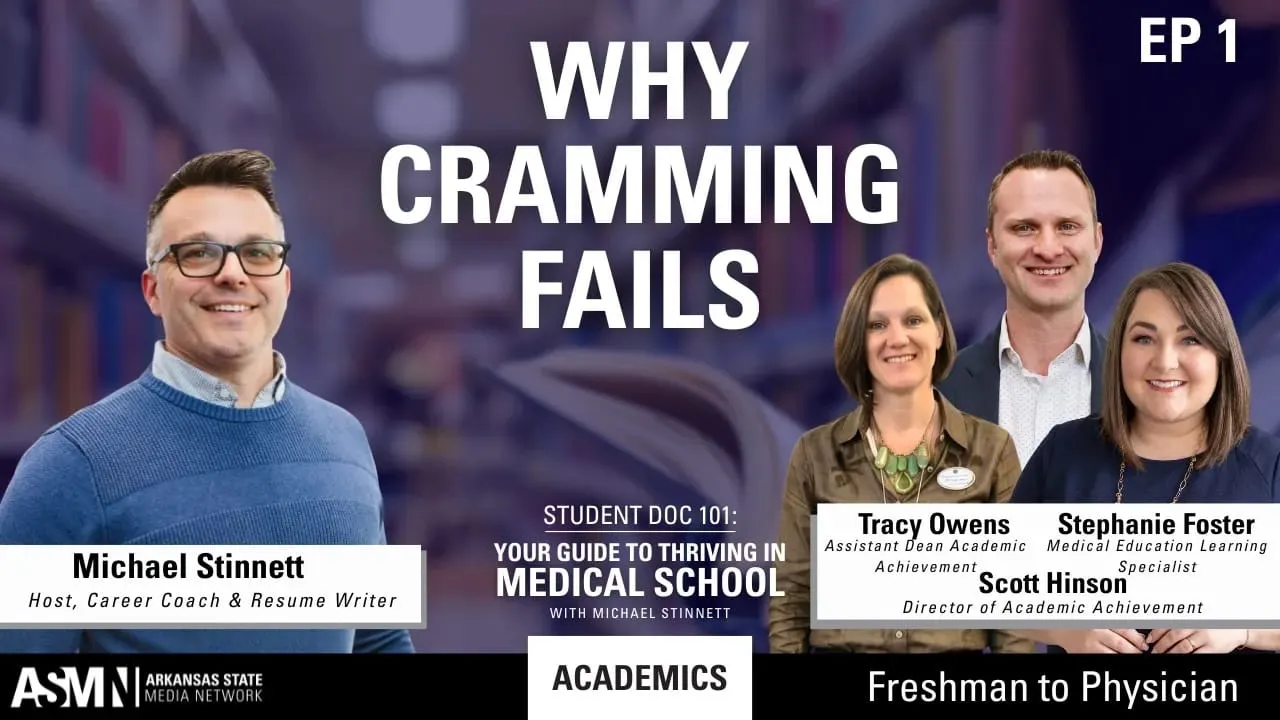
Medical school moves so fast that “working harder” can quietly become the thing that breaks you. We sit down with Dr. Tracy Owens (Assistant Dean of Academic Achievement), Dr. Scott Henson (Director of Academic Achievement), and Stephanie Foster (medical education learning specialist) to talk about what thriving actually looks like when the volume is massive, the pace is relentless, and you’re expected to think like a doctor from day one.
We also clear up the questions students keep asking about osteopathic medicine. We explain what the DO pathway means, how DO and MD training align for residency, and what’s distinct about a holistic, whole-person approach including the additional hands-on hours in Osteopathic Manipulative Medicine (OMM). If you’re choosing between programs or trying to understand “DO vs MD,” you’ll leave with clearer language and a better feel for fit.
From there, we get practical about preparation and performance: which undergrad courses help most, how nonfiction reading builds the skill of handling long board-style exams, and why spaced repetition beats cramming every time. We talk routines that protect your brain, including sleep and exercise, plus what academic coaching looks like in real life: building schedules, managing unstructured time, doing multiple passes, and learning how to read questions, catch distractors, and close knowledge gaps early.
We also name the invisible challenges students don’t expect: imposter syndrome, self-regulation, and the “algorithm lie” that pushes you to buy resources you may not need. If you want a smarter plan and a calmer path through medical school, hit play, then subscribe, share the episode with a friend, and leave us a review. What’s the biggest challenge you’re trying to solve before day one?
More About this Episode
Student Doc 101: Behind the Scenes of the Medical School Journey
In the latest episode of Student Doc 101, host Michael Stinnett explored the internal mechanics of medical education with experts from the NYIT College of Osteopathic Medicine (NYITCOM) at Arkansas State University.
The panel, including Tracy Owens, Scott Hinson, and Stephanie Foster, discussed how students can transition from simply surviving the rigors of medical school to truly flourishing in their future careers.
Defining Osteopathic Medicine
A primary focus of the discussion was the philosophy of osteopathic medicine (DO). Unlike a strictly symptom-based approach, osteopathic medicine is rooted in the belief that the mind, body, and spirit are interconnected.
DO students receive the same rigorous scientific training as their allopathic (MD) counterparts but with an additional 100 hours of training in Osteopathic Manipulative Medicine (OMM).
The goal of a DO is to treat the whole person, investigating lifestyle factors, environment, and physical alignment to help the body return to its natural state of healing. As Hinson noted, a DO doesn't just look for an ailment and a matching medicine; they look for the root cause within the context of the patient's entire life.
Preparing for the Velocity of Medical School
The panel emphasized that medical school moves with a volume and velocity that can shock even high-achieving students. To "hit the ground running," prospective students are encouraged to build a strong foundation before day one:
- Long-Term Retention: Approach undergraduate science courses not just as requirements to pass, but as foundational knowledge for a lifelong career.
- Reading Stamina: Boards are essentially high-stakes reading tests. Students should cultivate the ability to process dense, non-fiction text.
- Foundational Science: If electives allow, taking biochemistry, anatomy, or genetics in undergrad can prevent week-one burnout in medical school.
Optimization Through Habit and Science
The academic achievement team at NYITCOM views themselves as an optimization squad. They help students apply the "science of learning" to their daily routines. Key advice included:
- Spaced Repetition: Move away from "cramming," which only utilizes short-term memory. Instead, review material in multiple "passes" over time to ensure long-term retention.
- The Brain-Body Connection: Students often forego self-care to save time, but the panel argued that sleep and exercise are actually essential for memory consolidation.
- Identify and Close Gaps: Use practice tests early and often. It is better to identify a gap in knowledge three weeks before an exam than on the test day itself.
Overcoming Invisible Challenges
One of the most significant hurdles discussed was the psychological impact of medical school. Many students enter as top-tier performers and struggle with "imposter syndrome" when they encounter their first academic setback.
The team helps students identify when the lies they believe, such as "I just need to work harder and sleep less," are actually feeding their fear of failure. By working with academic coaches, students learn to be self-reflective and adaptable, changing their study strategies when the data shows a lack of progress.
The Traits of Success
To conclude, the panel shared the core traits that help students reach the finish line:
- Adaptability: The willingness to let go of old habits that no longer serve you.
- Consistency: Developing a plan and showing up for it every single day.
- Self-Reflection: Being honest about your progress and reaching out for help before a challenge becomes a crisis.
As the team at NYITCOM often says, the ultimate goal is to ensure that future physicians are equipped to care for their patients by first learning how to care for their own academic and personal well-being.
For those considering a future in medicine, the journey begins with being curious, staying flexible, and learning to "be like water" in the face of challenge.