
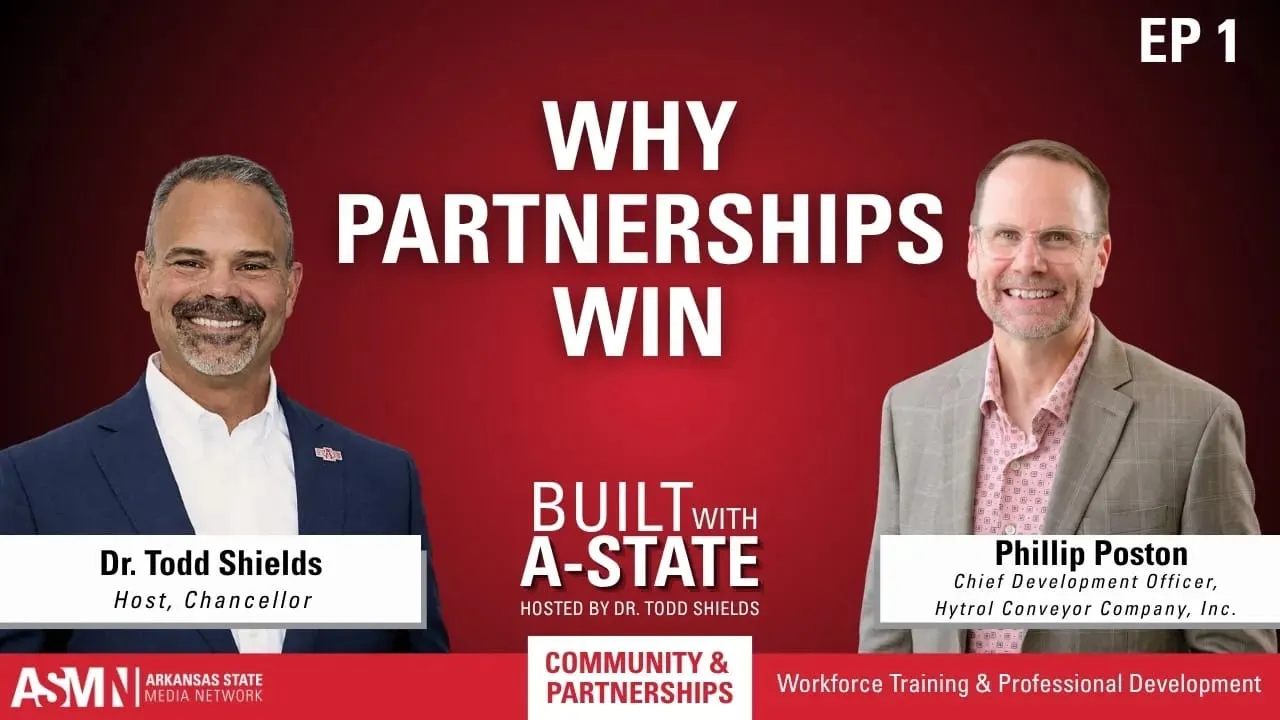
A university can hand you a diploma, but can it hand you a future? From a brand new podcast studio at Arkansas State University, we talk with Chancellor Todd Shields about a builder’s approach to higher education and why he believes students deserve a direct line from learning to a real career.
We get into the engine behind that promise: industry partnerships that tell the truth about today’s skills gap. Shields explains how A-State listens to employers, pressure-tests what students still need, and then updates programs without losing the rigor of accreditation. That can mean reworking curriculum, adding hands-on experiences, or embedding micro-credentials and industry certifications, such as IBM or Microsoft certificates so graduates stand out in hiring.
Along the way, we explore what makes A-State and Northeast Arkansas bigger than most people realize, including major regional industries and distinctive pathways that connect students to advanced health careers. If you care about workforce development, career-ready education, and talent pipelines that actually work, this conversation lays out a practical blueprint built around feedback, flexibility, and outcomes.
Subscribe for more conversations with leaders shaping Arkansas State, share this with someone choosing a college or hiring grads, and leave a review. What’s one skill you wish every graduate had on day one?
More About this Episode
Built with A-State: The Power of Strategic Industry Partnerships
In a deep-dive episode of Built with A-State, Chancellor Todd Shields welcomed Phillip Poston, Chief Development Officer at Hytrol Conveyor Company, to discuss the critical intersection of higher education and modern manufacturing.
Their conversation illuminated how long-term investments in people, infrastructure, and "micro-credentialing" are transforming Northeast Arkansas into a premier hub for technology and workforce readiness.
From Student Leadership to Executive Vision
Poston’s journey with Arkansas State University began as an undergraduate in the College of Business. He reflected on the profound impact of mentor professors who provided not just curriculum, but "constructive criticism" on professionalism.
Poston emphasized that his experience as president of Lambda Chi Alpha was a primary catalyst for his leadership development.
This foundation in accountability and networking transitioned into a 27-year career at Hytrol, where Poston now oversees strategic growth for a company that handles roughly 75% of the world's e-commerce logistics.
DRIVE and the Future of Workforce Training
Hytrol’s commitment to its employees is exemplified by the DRIVE Academy, an internal training program focused on five core pillars:
- Develop
- Retain
- Improve
- Value
- Engage
Chancellor Shields and Poston highlighted a major milestone in their partnership: the development of CREST (Career Readiness Education and Skills Training). This initiative is designed to bridge the gap between high school graduation and high-tech manufacturing careers.
CREST provides a physical and intellectual space where students can earn technical certificates or associate degrees while gaining hands-on experience with 2026-era robotics and automation.
Navigating the Inflection Point of AI and Cybersecurity
As technology evolves at an exponential rate, both leaders agreed that higher education must move faster. Poston argued that the industry is at an "inflection point" where Artificial Intelligence (AI) and Cybersecurity are no longer optional specialties; they are fundamental to every business operation.
Hytrol uses an internal app called Convey to train employees on phishing awareness and data protection. Similarly, A-State has launched a student-led cybersecurity group that provides real-world protection for the university system. Shields shared a startling statistic: the university faces over 100 cyberattack attempts even on a slow day, illustrating why hands-on training in this field is vital for the regional workforce.
Micro-Credentials: The New Currency of Learning
One of the most tactical shifts discussed was the use of micro-credentials. Because traditional course revamps can take years, micro-credentials allow A-State to integrate small, relevant training modules, such as specific Microsoft or IBM certifications, immediately.
This model supports lifelong learning, particularly for the "26 to 30" age demographic. These are professionals already in the workforce who need to upskill to qualify for leadership rungs without stepping away from their careers for a full degree.
Building a Flywheel for Northeast Arkansas
The conversation concluded with a shared vision for the growth of Jonesboro and the surrounding region. Poston, a member of the local connectivity committee, praised A-State’s leadership in creating a bike-able, walkable campus, a key factor in "quality of life" that attracts and retains young talent.
He urged local businesses to invest in the university’s ecosystem, whether through supporting the Alpha Pack or participating in events like the Skirmish Bike Race.
By aligning the university’s curriculum with the specific needs of advanced manufacturing, food processing, and steel production, Arkansas State and Hytrol are ensuring that the next generation of global leaders is built right here in Northeast Arkansas.