
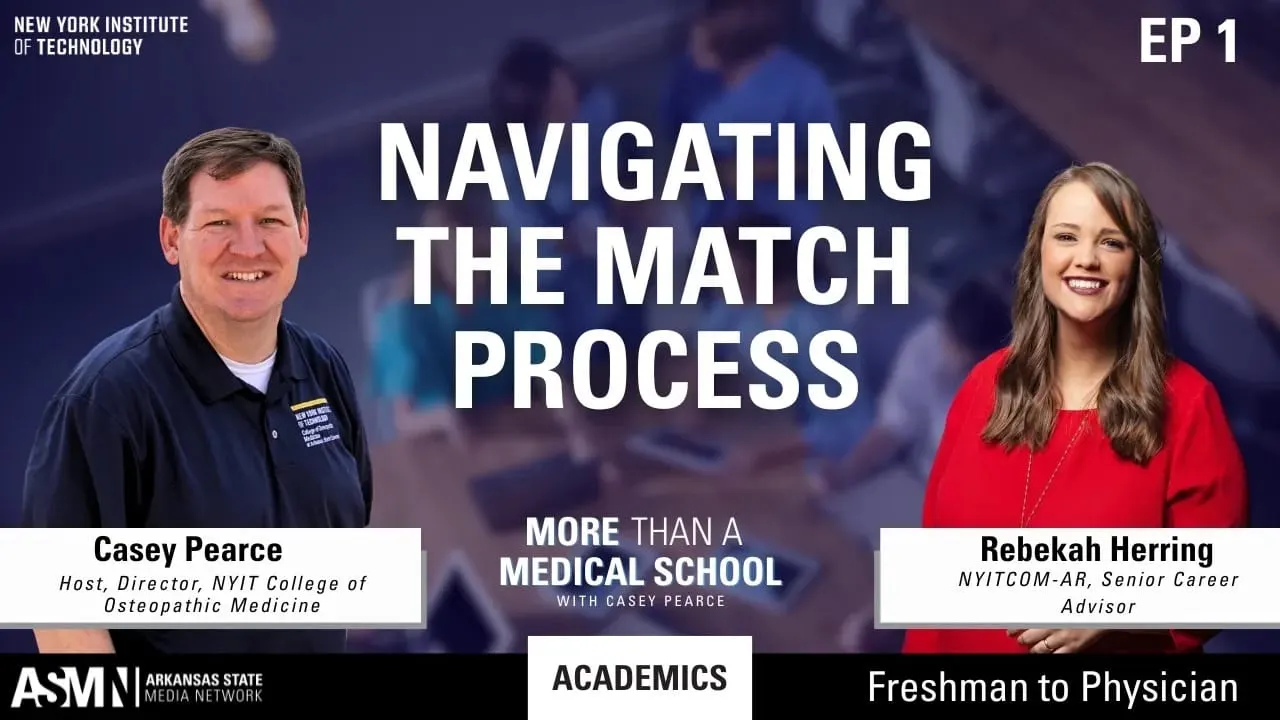
The residency Match can decide your specialty, your city, and the next several years of your life, yet most people only hear rumors about how it works. We sit down with Rebekah Herring, senior career advisor at NYIT College of Osteopathic Medicine, to explain the NRMP Match in plain language, including how rank lists become a legally binding contract once the algorithm runs.
We also get practical about what actually moves the needle. Rebecca walks through how career advising starts in the first week of medical school, why so many students change direction during third-year rotations, and how a strong plan keeps you on track for audition rotations and the right letters of recommendation. We dig into the building blocks of a competitive residency application and CV: academics, research, presentations and publications, leadership, service, mentoring, and teaching.
For osteopathic medical students, we cover the real-world nuances of COMLEX versus USMLE and why some competitive specialties may require extra preparation. We also talk about what happens if a student doesn’t match at first and how SOAP can lead to a successful placement.
Finally, we zoom out to mission and outcomes: primary care needs, keeping physicians close to underserved communities in Arkansas and the Delta, and why an active alumni network can open doors. Subscribe, share this episode with a future doctor, leave a review, and follow along at nyit.edu/arkansas and @nyitcomAR. Make sure to also follow us on socials @arkansasstatemedianetwork.
More About this Episode
More Than a Medical School: Navigating the Residency Match Process
In a recent episode of the More Than a Medical School podcast, host Casey Pearce sat down with Rebekah Herring, Senior Career Advisor at the NYIT College of Osteopathic Medicine (NYITCOM).
The discussion focused on the critical match process, a sophisticated algorithm that bridges the gap between medical school graduation and the start of a physician's residency training.
Understanding the Residency Match
The match is a formal system facilitated by the National Resident Matching Program. Unlike a traditional job search, medical students and residency programs participate in a mutual ranking system.
Students rank the programs they are most interested in, while residency programs rank the students they wish to recruit. An algorithm then pairs them together, creating a legally binding contract for the student to conduct their residency at that specific institution.
This process is the definitive moment where a medical student determines their future specialty, such as family medicine, orthopedic surgery, or pediatrics. While students spend their first two years in the classroom, the third year often serves as a turning point.
During clinical rotations, more than half of NYITCOM students change their minds about their specialty after gaining hands-on experience in different medical fields.
The Advantage of Dedicated Career Advising
A hallmark of the NYITCOM experience is the intensive support system provided to students from day one. Herring noted that many medical schools do not have dedicated career and residency advisors, making NYITCOM unique in its investment in student outcomes.
Advisors work with students throughout all four years to build a competitive curriculum vitae (CV). This includes:
- Academic Review: Detecting any red flags early to provide a path for improvement.
- Research and Publications: Guiding students toward research and national presentation opportunities.
- Leadership and Service: Encouraging involvement at both the community and national levels.
- Audition Rotations: Helping students secure letters of recommendation during their fourth year rotations.
Proven Success in Match and Placement Rates
Over the seven graduating classes since the Jonesboro campus opened ten years ago, NYITCOM has consistently exceeded national match averages.
While the initial match is the goal, the school also supports students through the Supplemental Offer and Acceptance Program (SOAP). This ensures that students who do not match in the first round find available positions to continue their training.
Through this dual approach of matching and placement, NYITCOM boasts a cumulative 99.9% success rate. This level of success spans across both primary care and highly competitive specialties, including:
- Dermatology
- Orthopedic Surgery
- Radiation Oncology
- Diagnostic Radiology
- Ophthalmology
The Mission for Arkansas and Beyond
While NYITCOM students match at prestigious national institutions like Yale, Harvard, and the Mayo Clinic, the school remains deeply committed to its mission in Arkansas and the Delta region. Roughly 25% of graduates remain in Arkansas for their residency training.
Statistics show that nearly 70% of physicians end up practicing within a 100 mile radius of where they complete their residency. This makes the growth of residency programs within Arkansas vital to the state's healthcare future.
Currently, many NYITCOM alumni are practicing in Jonesboro and surrounding rural areas, often serving as healthcare providers for the current generation of medical students.
A Lifetime Connection: The Alumni Network
The support system for NYITCOM students extends beyond the faculty and staff. The school has prioritized building a robust alumni network, facilitating over 200 mentorship connections in the last year alone.
Because these alumni have navigated the match process recently, they provide invaluable, fresh perspectives to current students.
Pearce emphasized that the foundation of the school is intentional relationship building. By earning student trust during their four years on campus, the university creates a cycle of mentorship that benefits future patients and the entire medical community.