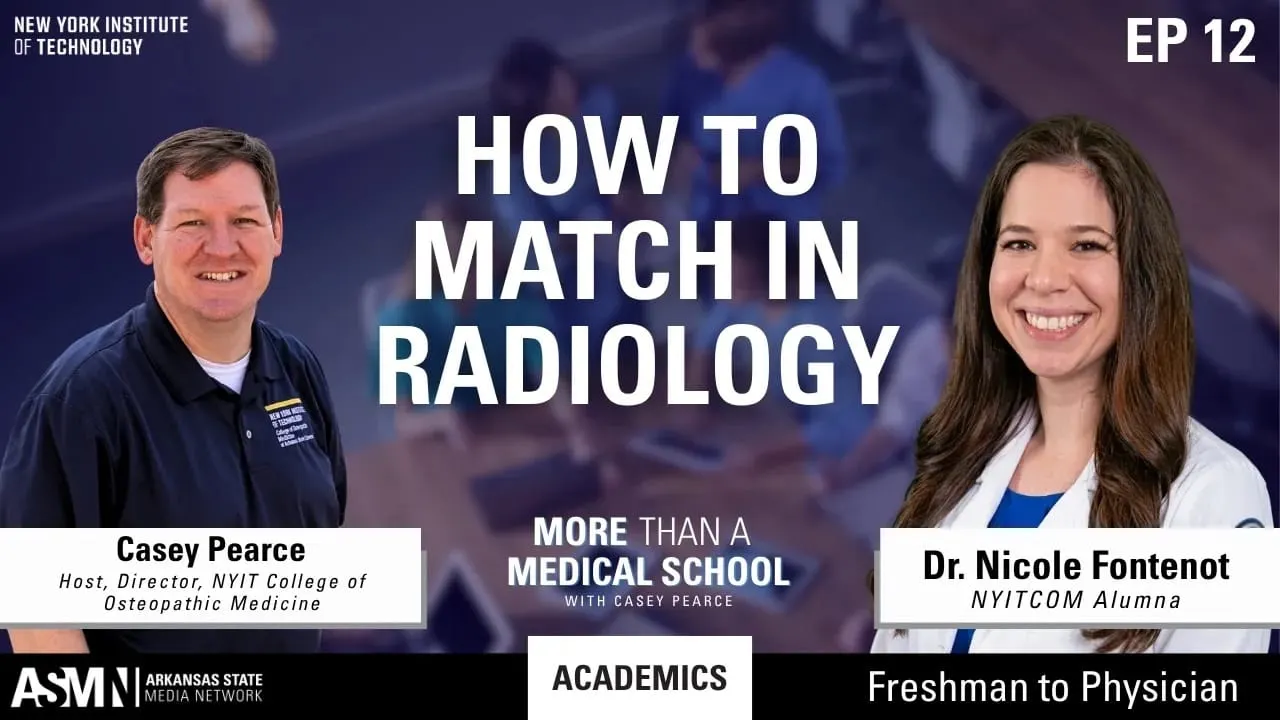
A nationwide shortage of 10,000 radiologists is transforming how and where these specialists practice. Dr. Nicole Fontenot, a diagnostic radiology resident, unpacks her unconventional path from rural rad tech to physician.
She breaks down the workflow of modern reading rooms, highlighting the exhausting pace of clearing massive image queues. Artificial intelligence isn't taking over the specialty just yet. Instead, current machine learning tools frequently generate false positives and serve better for basic triaging rather than independent diagnosis.
For prospective medical students anxious about competitive specialties, this conversation provides a concrete strategy for networking and navigating the residency match process. Subscribe and share this episode with a classmate mapping out their clinical rotations. How do you think artificial intelligence will actually change your target medical specialty?
More About this Episode
Navigating the Path to Diagnostic Radiology: Medical School, Artificial Intelligence, and the Modern Physician Lifestyle
When prospective medical students ask about the future, their questions typically revolve around where they will end up, what specialties they can pursue, and what their daily lives will look like. The truth is that a foundational medical education can take you anywhere. One of the most fascinating and rapidly evolving fields in modern medicine is diagnostic radiology. It is a specialty that operates behind the scenes but heavily influences nearly every aspect of patient care. By looking at the journey of physicians who have navigated this path, we can uncover exactly what it takes to succeed in medical school, match into a highly competitive residency, and thrive in a specialty that is currently experiencing massive technological and structural shifts.
The Nontraditional Route to Medical School
The journey to becoming a physician does not always follow a straight line. Many successful doctors begin their careers in other areas of healthcare before making the leap to medical school. Taking a nontraditional route often provides a unique perspective and a deep well of clinical experience that proves invaluable during residency.
For some, the initial thought of becoming a doctor is daunting. The immense responsibility and the weight of patient care can be intimidating to a high school student. However, life has a way of shifting our perspectives. An unexpected event, such as a severe car accident, can serve as a powerful catalyst. Experiencing the healthcare system firsthand as a patient can ignite a curiosity about the science of healing. For example, a specialized cervical spine X-ray taken through an open mouth might seem strange to a teenager, but it can spark a lifelong fascination with medical imaging.
This initial curiosity often leads students to pursue degrees in radiologic technology. Working as a rad tech provides hands on experience with patients and medical technology. More importantly, it places aspiring medical professionals in the same room as established physicians. Mentorship plays a critical role in the transition from technologist to physician. A radiologist who takes the time to explain the nuances of a scan can inspire a technologist to return to school, complete their premedical coursework, and apply to a college of osteopathic medicine.
This path requires immense dedication. It often means working overnight shifts at pediatric hospitals performing CT scans and X-rays while attending challenging science classes during the day. It is a grueling schedule, but it builds the resilience necessary to survive the rigors of medical school and board exams.
Demystifying Diagnostic Radiology
There is a common misconception that radiologists are recluses who sit in dark basement reading rooms, completely isolated from the rest of the medical staff and patients. The reality of the specialty is entirely different. Diagnostic radiology is an incredibly dynamic and collaborative field. Radiologists are often referred to as the doctor's doctor. They help guide the treatment plans for almost every other specialty in the hospital.
A radiologist touches everything related to medical imaging. They interpret cardiac MRIs to assess heart function. They read mammograms and communicate directly with patients regarding their breast health. They work closely with orthopedic surgeons, neurosurgeons, and emergency medicine physicians. A surgeon needs to know exactly what they are walking into before they enter the operating room, and the radiologist provides that critical roadmap. In trauma situations, emergency room doctors rely on rapid wet reads from radiologists to make split second decisions that save lives.
While patient contact might look different than it does in family medicine, radiologists still interact with patients regularly. They perform specialized procedures, administer biopsies, and discuss imaging results. Furthermore, radiologists can choose to be generalists who see a wide variety of cases, or they can subspecialize to become experts in a specific area like musculoskeletal imaging or neuroradiology.
The Shortage and the Shifting Lifestyle
The landscape of diagnostic radiology is currently shifting heavily in favor of the physician. There is a massive nationwide shortage of radiologists. Recent estimates suggest the country is short by roughly ten thousand radiologists. Residency programs are graduating fewer than two thousand new radiologists each year, which is not enough to replace retiring doctors, let alone keep up with the soaring demand for medical imaging. Today, it is incredibly rare for a patient to walk through emergency room doors without receiving some form of imaging, whether it is a simple X-ray or a comprehensive scan of the brain and spine.
This high demand has revolutionized the radiology lifestyle, especially in the post pandemic world. Previously, obtaining a flexible schedule or utilizing teleradiology meant working grueling overnight shifts. Now, physicians have unprecedented control over their schedules. If a radiologist wants to work a standard Monday through Friday schedule in a hospital, those jobs are abundant. If they prefer to work from home via teleradiology, they can set up a sophisticated home workstation with multiple high resolution monitors to review clinical histories, old imaging, and current scans simultaneously.
This flexibility is a massive draw for medical students who prioritize a healthy work and life balance. The ability to tailor a career to fit the needs of a growing family makes radiology one of the most highly sought after specialties in modern medicine.
The Role of Artificial Intelligence in Radiology
Whenever technology and radiology are discussed, the topic of artificial intelligence inevitably arises. A frequent question is whether AI will eventually replace human radiologists. The short answer is no. Radiologists do not fear artificial intelligence; they welcome it as a much needed supplemental tool.
Diagnostic radiology requires a five year residency, and even seasoned attendings who have practiced for decades regularly encounter pathologies they have never seen before. Because AI relies on being fed historical data, it struggles to interpret novel presentations or highly complex, nuanced cases. A computer program lacks the critical thinking skills required to synthesize a patient's clinical history, recent lab values, and surgical records to arrive at a definitive diagnosis.
The medical community has actually been using rudimentary forms of AI for over two decades. Computer aided detection in mammography is a prime example. Even after twenty years of refinement, these systems still produce a high rate of false positives. Emergency room doctors frequently flag potential fractures identified by AI that turn out to be nothing upon human review. Current AI systems are also highly fragmented and incredibly expensive. A software package that detects lung nodules on a CT scan cannot detect a large vessel occlusion in a stroke patient. Most hospital systems, especially in rural areas, simply cannot afford to implement a massive suite of single function AI programs.
Where AI holds true promise is in workflow triage. Radiologists are currently overwhelmed by the sheer volume of scans they must read. A physician can only read so fast while maintaining accuracy and ensuring patient safety. If an artificial intelligence program could scan a worklist and push critical, actionable findings to the top, it would revolutionize patient care. If AI can instantly alert a radiologist that a patient an hour down the list has a punctured lung or an active brain bleed, the radiologist can immediately contact the ordering clinician and expedite life saving treatment.
Balancing Family Life and Medical Education
Pursuing a medical degree is challenging under the best of circumstances, but doing so while raising a family adds an entirely new layer of complexity. For nontraditional students with toddlers at home, the transition into medical school requires a massive mental shift.
In a traditional career, you can often leave your work at the office when you clock out. Medical school does not afford that luxury. The sheer volume of material requires hours of rigorous study outside the classroom. Young children do not understand why a parent cannot play on a Saturday afternoon because they have to prepare for a pharmacology exam.
Success in this environment requires strict boundaries and exceptional time management. Medical students who are parents must treat their education like a demanding full time job. They must maximize their focus during business hours so that when they are home, they can be fully present with their children.
It is also vital to abandon pride and ask for help. Building a supportive village of family, friends, and understanding classmates is nonnegotiable. There will be missed birthday dinners and skipped social events. The sacrifices made on the front end are difficult, but they pave the way for a highly rewarding career that will ultimately benefit the entire family.
Advice for Future Physicians
For undergraduate students preparing to apply to medical school, it is crucial to take the MCAT incredibly seriously. Medical school coursework operates on an entirely different level than undergraduate studies. Students who are accustomed to easily earning high grades often face a rude awakening during their first semester of medical school. The grind of learning does not stop after graduation; it accelerates. Medicine requires a commitment to lifelong learning. Even senior physicians constantly read new journal articles and attend conferences to stay updated on changing clinical guidelines.
Additionally, networking and building relationships are vital components of a successful medical career. Medicine is a surprisingly small world, and specialty circles like radiology are even smaller. Students should actively seek out shadowing opportunities, attend medical conferences, and introduce themselves to practicing physicians.
When it comes time to apply for residency, performing away rotations is highly recommended. Spending significant time in a hospital's reading room allows a student to understand the day to day realities of the specialty. It also gives residency program directors a chance to evaluate the student's work ethic and personality. Test scores matter for getting an interview, but ultimately, programs want to hire residents who are dedicated, eager to learn, and easy to work with during long, demanding shifts.
The path to becoming a diagnostic radiologist is filled with difficult exams, long nights, and significant personal sacrifices. However, for those who are willing to put in the work, it offers a deeply fulfilling career. It provides the opportunity to utilize cutting edge technology, collaborate with brilliant colleagues across every medical specialty, and make a profound impact on patient care from behind the screens.