
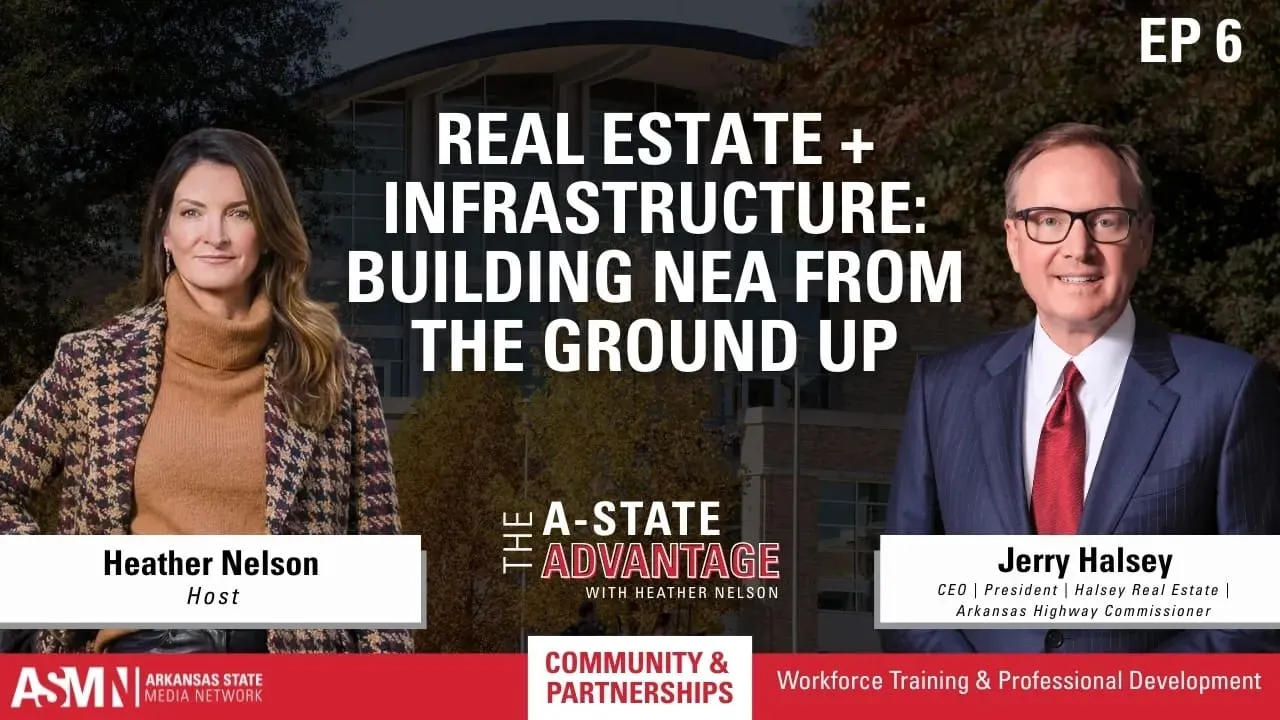
Infrastructure delays and disconnected communities are silent killers of regional economic growth. With Northeast Arkansas experiencing massive population booms and industrial expansion, understanding how real estate, roadways, and higher education intersect has never been more critical for local leaders and investors. To break down how these pieces fit together, we sit down with Arkansas Highway Commissioner Jerry Halsey, a fourth-generation real estate leader and the developer behind the $100 million Greensboro Village project.
We get into the mechanics of building a regional empire from the ground up, tracing his family’s transition from farming to managing a multi-state property brokerage. Our conversation highlights the reality of master-planned mixed-use developments, the strategic vision behind the "Steel Beltway," and how public-private partnerships can solve infrastructure bottlenecks. At the core of his success is a foundational philosophy: in an era dominated by AI and automated text messaging, picking up the phone and having face-to-face, unguarded conversations remains the ultimate differentiator in business.
Mega-developments and state highway projects rarely follow a straight line, often stalling for years due to complex zoning hurdles, failed tax initiatives, and flat statewide revenue battling rising construction costs. We examine the logistical friction of holding out for anchor tenants, like grocery stores and theaters, while carrying the financial risk of multi-year development cycles. Viewers will walk away with a practical framework for exercising patience in long-term real estate plays, along with a clearer understanding of how citizen advocacy directly impacts local roadway funding and economic survival.
If you care about real estate development, regional infrastructure, and building sustainable community wealth, you’ll get a lot from this. Make sure to subscribe to the channel and share this episode with fellow founders, developers, and leaders who want a boots-on-the-ground perspective on economic growth. What is the biggest infrastructure or development challenge currently facing your local community? Leave your thoughts in the comments below.
@arkansasstatemedianetwork.com.
More About this Episode
Building the Future of Northeast Arkansas: Infrastructure, Master-Planned Real Estate, and the Power of Regional Vision
Northeast Arkansas is standing at the precipice of an unprecedented economic transformation. Across the region, a powerful convergence of industrial investment, educational advancement, and strategic real estate development is reshaping the landscape. From multi-million-dollar master-planned communities rising near Arkansas State University to massive infrastructure projects designed to connect thriving industrial corridors, the momentum is undeniable.
Understanding how a region successfully scales requires a close look at the intersection of leadership, family legacy, infrastructure planning, and higher education. When local developers, highway commissioners, and university leaders align their visions, growth ceases to be accidental. Instead, it becomes a carefully orchestrated economic engine capable of sustaining communities for generations to come.
From Cotton Fields to Commercial Real Estate: The Pillars of a Fourth-Generation Legacy
Long-term regional development is often built on the foundation of generational commitment. In Northeast Arkansas, deep agricultural roots frequently provide the bedrock for modern entrepreneurship. Navigating the transition from traditional farming, such as cotton and watermelon harvesting, into commercial real estate and property management requires both adaptability and a profound respect for heritage.
True lasting success in family enterprise relies on intentional evolution. Making major generational shifts, such as selling ancestral farmland to reinvest capital into burgeoning urban real estate markets like Jonesboro, demands collaborative, family-wide decision-making. These pivots are not made lightly; they are calculated risks discussed around office tables and during long vehicle drives, ensuring that every generation understands the weight of their investments.
A vital lesson for modern business leaders is the importance of fostering lifelong learning and adaptability within a family structure. Witnessing a parent pivot mid-career to pursue advanced education or a law degree instills a permanent understanding that personal growth has no expiration date. Today, as fifth-generation family members step into leadership roles within property management and development firms, they bring fresh perspectives that are vital for navigating modern markets. Integrating adult children into the decision-making process ensures that the strategies enacted today will be passionately managed and sustained by the very people who helped shape them.
The Human Element of Business in an AI World
We are operating in an era dominated by artificial intelligence, automated efficiency, and digital messaging. While modern technological tools offer undeniable productivity spikes, relying too heavily on digital communication can erode the foundational trust required in high-stakes industries like real estate and development.
When clients entrust professionals with multi-million dollar property assets, or when business leaders must negotiate complex regional partnerships, text messages and automated emails fall short. Texts and emails are excellent vehicles for carrying static information, such as bullet points, documents, and data attachments. However, when it comes to establishing a plan of action, resolving nuanced problems, or understanding the genuine emotional state of a client, nothing replaces a direct phone call or an in-person meeting.
Core Principles for Effective Professional Communication
- Tackle Problems Immediately: When a potential issue arises, address it first thing in the morning. Allowing a problem to fester creates unnecessary anxiety for both the professional and the client.
- Listen for Unguarded Insights: Late-afternoon or after-hours phone calls are rarely confrontational. Most of the time, clients simply want to share their thoughts, offer updates on their properties, or seek informal counsel. Answering the phone builds deep, lasting rapport.
- Prioritize Quality Over Volume: Automated systems might allow a business to process one hundred superficial tasks, but long-term authority is built by executing fifteen or twenty meaningful projects with absolute excellence and personalized care.
- Build Confidence Through Direct Contact: Younger professionals entering the workforce often default to text-based communication. Pushing the next generation to conduct presentations and engage in direct, face-to-face dialogue visibly elevates their professional confidence and negotiation capabilities.
Greensboro Village and the Anatomy of Master-Planned Development
Developing a massive, master-planned mixed-use community is a testament to professional endurance. Projects of this scale, such as the 200-acre Greensboro Village development situated just a stone's throw from Arkansas State University, do not materialize overnight. They require navigating a complex web of land acquisition, municipal zoning, infrastructure funding, and economic cycles.
The trajectory of a hundred-million-dollar development is rarely a straight line. Taking a massive parcel of land from concept to reality often involves rewriting local zoning ordinances to accommodate innovative walkability and mixed-use standards modeled after successful urban planning frameworks seen in cities like Nashville. Developers must work hand-in-glove with city planners, utility providers, and municipal leaders to build consensus around a shared vision.
Overcoming Roadblocks in Large-Scale Development
- Zoning and Regulatory Hurdles: Introducing modern mixed-use concepts into growing regional municipalities often requires drafting entirely new zoning definitions, a process that can take months of careful negotiation and public hearings.
- Infrastructure and Public Funding: Securing the necessary road networks and utility infrastructure sometimes relies on public tax initiatives. When municipal tax measures fail at the ballot box, private developers must pivot, reassess their timelines, and find alternative ways to lay the groundwork.
- Macroeconomic and Global Shocks: Securing a major commercial anchor, such as a premier cinema or retail complex, provides the gravitational pull needed to sell surrounding commercial parcels. However, unforeseen global events can stall opening dates by months or years, forcing developers and investors to exercise immense financial patience.
Despite these inevitable hurdles, the compounding effect of persistence eventually takes hold. Once foundational infrastructure is completed and commercial anchors open their doors, development velocity accelerates rapidly. Within a 36 to 48-month window, stalled fields transform into vibrant residential neighborhoods, bustling office parks, hospitality centers, and retail dining hubs that serve the expanding regional population.
The "Steel Beltway" and the Power of Regional Connectivity
To understand the future of Northeast Arkansas, one must stop viewing cities like Jonesboro, Paragould, Blytheville, Osceola, and Marked Tree as isolated islands. True economic resilience lies in regionalism. When municipalities operate as a unified economic corridor, the entire population benefits from shared workforce resources, diversified housing options, and enhanced quality of life.
The catalyst for this regional integration is transportation infrastructure. A prime example of this visionary planning is the concept of the "Steel Beltway," a comprehensive highway loop designed to seamlessly connect the booming industrial sector in Mississippi County with the commercial and educational hubs of Craighead County and beyond.
Transforming Rural Communities Through Highway Infrastructure
- Accelerating Industrial Access: Connecting major industrial anchors, such as Big River Steel, directly to Highway 18, Interstate 55, and Interstate 555 via four-lane divided highways allows commercial freight and daily commuters to travel safely and efficiently at highway speeds.
- Revitalizing Small Towns: When smaller agricultural communities like Caraway, Monette, Manila, and Leachville gain direct, high-speed access to regional bypasses and interstates, they experience immediate economic revitalization. These towns transform into attractive, accessible residential hubs for families seeking rural lifestyles without sacrificing career mobility.
- Expanding Workforce Optionality: A robust regional highway network allows individuals to live in rural districts while commuting just twenty or thirty minutes to high-paying advanced manufacturing jobs, healthcare facilities, or university classrooms.
- Enhancing Safety and Quality of Life: Divided multi-lane highways dramatically reduce traffic accidents and transit times, ensuring that school sports teams, daily commuters, and commercial shippers can navigate the region safely.
This level of connectivity mirrors the transformative infrastructure boom that reshaped Northwest Arkansas during the 1990s. Just as interstate expansions linked isolated towns into a global economic powerhouse, strategic highway investments in Northeast Arkansas are laying the groundwork for decades of sustained, multi-county prosperity.
ARDOT Realities, Public-Private Partnerships, and Local Impact
Turning visionary highway concepts into asphalt realities is a monumental task that requires decades of dedicated leadership. Major infrastructure routes, such as the development of Interstate 57, often span fifty years from their initial conceptualization by state highway commissioners to their ultimate completion.
Today, state transportation agencies like the Arkansas Department of Transportation (ARDOT) face a challenging economic equation: construction and maintenance expenses are rising rapidly due to inflation, while traditional revenue streams remain relatively flat. To maintain momentum on critical regional corridors, transportation leadership must look beyond conventional funding models.
Navigating the Future of Infrastructure Funding
- Public-Private Partnerships (P3s): As multi-billion dollar industrial corporations establish roots in Northeast Arkansas, opportunities emerge to form coalitions between private industry, county governments, and state transportation boards. Engaging corporate stakeholders in infrastructure funding ensures that heavy industrial roads are built to withstand immense commercial demands.
- Transparent Public Messaging: Securing voter approval for local infrastructure investment requires clear, honest communication. Citizens must see road funding not as an intrusive tax, but as a direct, generational investment in the safety and economic viability of their hometowns.
- Localizing Engineering and Oversight: Establishing localized transportation offices, such as the ARDOT satellite office in Jonesboro, creates a profound strategic advantage. When highway engineers and project managers live in the communities they serve, they drive the roads daily, experience the traffic bottlenecks firsthand, and collaborate directly with local municipal leaders to oversee more than $130 million in active regional projects.
Arkansas State University: The Heart of Regional Economic Expansion
No regional economic vision is complete without an anchor institution driving innovation, research, and talent retention. Arkansas State University (A-State) serves as the intellectual and professional heartbeat of Northeast Arkansas. Experiencing record enrollment growth that pushes the student population toward the 20,000 mark, the university is actively reshaping the demographic and professional landscape of the mid-South.
The ultimate measure of a regional university's success is its ability to attract students from across the nation, equip them with world-class education, and retain them as permanent residents and community leaders. Whether a student arrives to study osteopathic medicine, veterinary science, advanced engineering, or business finance, spending four to eight years in Jonesboro embeds them deeply into the fabric of the community.
Aligning Higher Education with Industry Demands
- Responsive Curriculum Development: Progressive university leadership actively collaborates with incoming industries. Instead of imposing rigid academic structures, educational leaders ask industrial giants what specific skills and technologies they require, swiftly adapting curriculum to produce graduates tailored for high-paying local careers.
- Direct Pipeline to Employment: By integrating corporate internships, specialized research initiatives, and on-site industrial training into the academic journey, students transition seamlessly from the graduation stage into lucrative regional professions.
- Cultivating Lifelong Alumni Pride: A successful university understands that its mission extends far beyond commencement. Building strong relationships with alumni across decades creates a powerful cycle of mentorship, private investment, and institutional pride that feeds directly back into the regional economy.
A Vision for the Next Thirty Years
When robust infrastructure, forward-thinking municipal planning, thriving family enterprises, and an elite research university move in absolute synchronization, the potential of Northeast Arkansas becomes limitless. Over the next twenty to thirty years, the region is poised to become a self-sustaining economic powerhouse where communities thrive, industries innovate, and future generations build prosperous lives without ever feeling the need to leave home.
Achieving this dream requires continuous collaboration, open-minded public discourse, and a steadfast commitment to investing in the foundational systems that carry our communities forward. The groundwork has been laid by visionary leaders of the past; the responsibility now rests on today's builders, educators, and citizens to finish the roads, develop the communities, and realize the extraordinary promise of our region.