
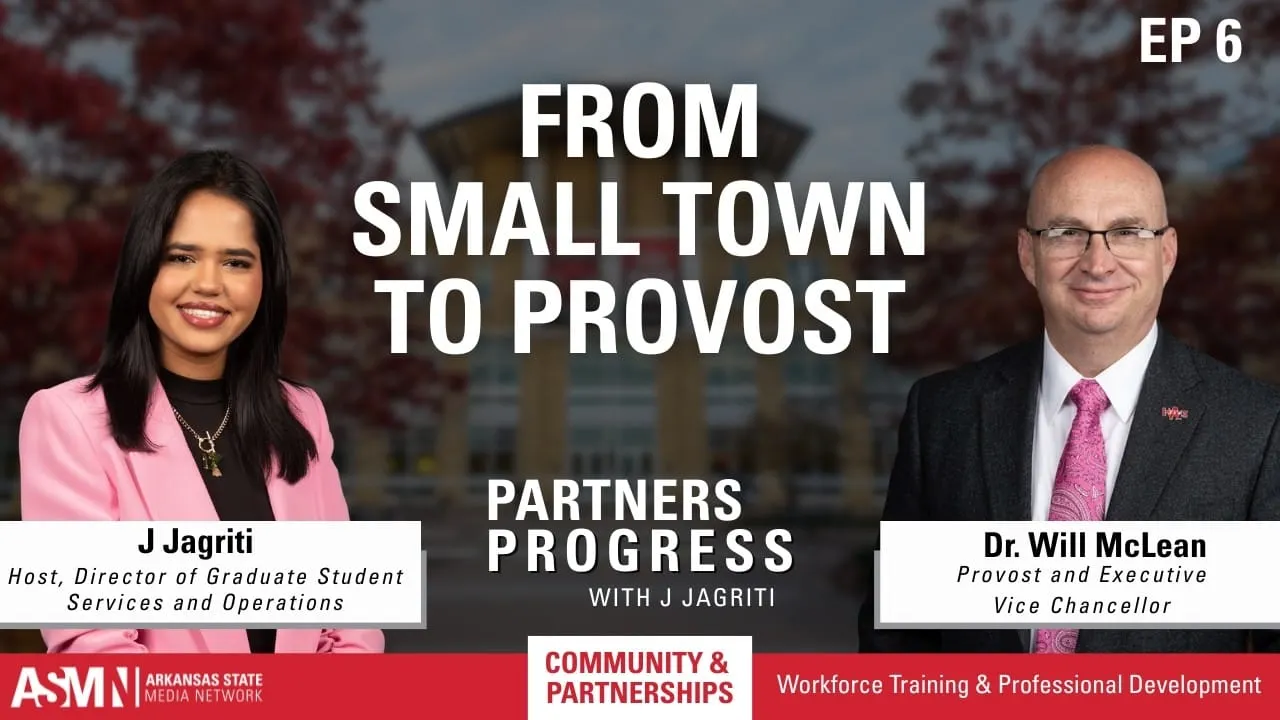
Institutional momentum stalls the moment academic leadership loses sight of its core identity. With regional universities facing shifting demographic cliffs and intense competition for resources, understanding how to scale infrastructure while serving local communities is critical right now, especially as institutions prepare for massive fall enrollment shifts and infrastructure launches. We sit down with Dr. Will McLean, A-State alumnus and Interim Provost and Executive Vice Chancellor for Academic Affairs and Research, who brings decades of rural Delta research and faculty experience to the executive leadership table.
We get into the operational reality of managing unprecedented campus growth while keeping teaching at the center of the university's mission. The conversation covers the mechanics behind Arkansas State's record-breaking $47 million research award, the cross-pollination of artificial intelligence and engineering within the new Windgate Art and Innovation Center, and the accelerated timeline of building the state's first College of Veterinary Medicine. Dr. McLean shares his leadership philosophy that institutional continuity is only valuable when the existing vision is actually driving results, emphasizing that long-term faculty support is the true engine behind sustainable institutional growth.
Opening two major flagship complexes simultaneously while building out new professional doctoral programs presents immense logistical, financial, and operational challenges that require precise alignment with regional industry needs. Managing this level of expansion means making hard decisions about resource allocation without diluting the quality of undergraduate instruction or raising costs beyond the reach of local families. Viewers will walk away with a clear blueprint for how regional universities can balance high-level research aspirations with affordable education, along with practical advice on how emerging leaders can navigate transitional roles by learning the internal budgeting and personnel realities of executive management.
If you care about higher education strategy, rural community development, and sustainable institutional scaling, you’ll get a lot from this. Make sure to subscribe to the channel and share this episode with your network of educators, founders, and leaders. What is the most critical professional or workforce development program your local region needs built out right now? Drop your thoughts in the comments below.
@arkansasstatemedianetwork.com.
More About this Episode
Scaling Regional Universities: Balancing Research Infrastructure and Workforce Development in the Delta
The landscape of higher education is undergoing a seismic shift. Regional universities across the country are navigating shifting demographic cliffs, intensifying competition for funding, and escalating demands for rapid workforce development. In the middle of these pressures, institutional momentum often stalls the exact moment academic leadership loses sight of its core identity. When institutions prioritize superficial growth over sustainable infrastructure, they risk alienating the local communities they were established to serve.
Navigating these complex operational realities requires a clear blueprint for institutional growth. By examining the leadership strategies and operational mechanics driving Arkansas State University through its current period of historic expansion, we can uncover how regional institutions can successfully scale high-level research infrastructure while preserving affordable, teaching-focused undergraduate education. With insights grounded in decades of rural Delta research and executive leadership, this analysis explores the critical intersections of academic continuity, interdisciplinary innovation, and regional economic development.
The Value of Academic Leadership Continuity
One of the most persistent threats to long-term momentum in higher education is executive volatility. When leadership turnover occurs too frequently, strategic initiatives are abandoned mid-cycle, budgets become fragmented, and faculty morale inevitably degrades. True institutional continuity is not about preserving the status quo for the sake of comfort. It is only valuable when the existing vision actively drives measurable results in the classroom, the research laboratory, and the broader community.
For regional universities, sustainable institutional growth relies heavily on bridging the gap between executive administration and the faculty. When leaders transition from decades of classroom teaching and rural Delta research into executive decision-making, they bring an essential operational reality to the cabinet table. They understand that long-term faculty support is the primary engine behind university growth. Faculty members are the individuals who mentor undergraduates, write competitive grant proposals, and build the regional industry partnerships that sustain the institution over decades.
Emerging academic leaders must navigate transitional executive roles by mastering the internal budgeting and personnel realities of university management without losing their connection to the academic core. When administration aligns its fiscal resource allocation directly with faculty development and tenure support, the entire institution gains the resilience required to handle massive enrollment shifts. Leadership continuity functions as a stabilizing force, ensuring that long-term infrastructure projects survive the inevitable cycles of state funding and demographic fluctuation.
Fueling a Record Research Boom in a Regional Ecosystem
Regional universities have traditionally been viewed primarily as teaching institutions, but modern economic realities demand a more dynamic approach. Balancing high-level research aspirations with an unwavering commitment to undergraduate instruction is a complex administrative challenge. Yet, when executed correctly, research expansion directly elevates the quality of teaching rather than detracting from it.
The mechanics behind securing record-breaking external funding, such as Arkansas State University's remarkable 47 million dollar research boom, depend heavily on intentional infrastructure scaling and strategic alignment with regional industries. This level of extramural growth does not occur by accident. It requires建立 a systematic pipeline that empowers early and mid-career researchers to compete for federal grants, private foundation awards, and industry partnerships. By investing in professional development, mentorship programs, and seed funding for preliminary data collection, universities can transform their faculty into competitive national researchers.
Crucially, this research surge must remain tethered to the local ecosystem. In regions like the rural Delta, research portfolios that focus on agricultural biosciences, advanced materials, and public health directly address local economic vulnerabilities while attracting federal investment. By integrating undergraduate and graduate students directly into these funded research projects, regional institutions create a dual benefit. Students gain hands-on, career-defining laboratory experience, while the university generates the intellectual property and specialized workforce required to attract technological and industrial employers to the region.
Interdisciplinary Innovation and the Windgate Art and Innovation Center
As the demands of the modern workforce evolve, the traditional boundaries separating academic disciplines must be dismantled. The rapid acceleration of artificial intelligence, advanced manufacturing, and digital media requires a collaborative approach to campus infrastructure. Building facilities that actively promote cross-pollination between disparate fields is no longer an optional luxury. It is an operational necessity for universities preparing students for a technologically complex marketplace.
The establishment of cutting-edge complexes like the Windgate Art and Innovation Center illustrates how regional universities can structurally enforce interdisciplinary collaboration. By housing artificial intelligence research, computer science, engineering, and creative arts under a single roof, institutions create an environment where technical precision meets creative problem-solving. This physical convergence encourages faculty and students to step outside traditional academic silos.
In practice, this cross-pollination allows engineering students to collaborate with design thinkers to create intuitive human-machine interfaces, while artificial intelligence researchers work alongside digital artists to explore generative algorithms and spatial computing. Managing this level of academic integration requires flexible administrative frameworks. Academic leaders must design curricula and credit-sharing models that reward cross-departmental collaboration rather than penalizing it through antiquated budgetary structures. When infrastructure is designed to foster collision between disciplines, the university becomes a regional hub for technological innovation and creative entrepreneurship.
Addressing Regional Workforce Needs: Launching the State's First College of Veterinary Medicine
Perhaps the most critical test of regional university leadership is the ability to identify a severe regional workforce deficit and mobilize the resources required to solve it. Across many rural and agricultural regions, the shortage of specialized professional services directly threatens economic stability and public health. In Arkansas, the accelerated timeline to construct and launch the state's first College of Veterinary Medicine represents a bold, targeted response to a documented agricultural and companion-animal crisis.
Opening a major professional doctoral program while simultaneously managing existing campus expansion presents immense logistical, financial, and operational challenges. Veterinary medical education requires specialized laboratories, clinical teaching hospitals, extensive accreditation hurdles, and highly competitive faculty recruitment. Executing an expansion of this magnitude demands precise alignment with regional industry leaders, agricultural associations, and state policymakers.
The executive challenge lies in making hard decisions regarding resource allocation. Capital must be deployed efficiently to construct state-of-the-art veterinary facilities without diluting the funding required for existing undergraduate programs. Furthermore, university administration must structure tuition and fee models that keep these advanced degrees accessible to students from local families. By creating a domestic pipeline of veterinary professionals who are educated locally, the institution ensures that these graduates remain in the region to support rural agricultural economies and community animal health.
Anchoring Locally While Competing Globally
The overarching strategic imperative for modern regional universities is mastering a dual mandate: anchoring firmly in the immediate cultural and economic needs of the local community while simultaneously expanding a global research and educational footprint. An institution that focuses solely on global prestige risks losing its legislative support and regional identity. Conversely, a university that ignores global technological and academic advancements fails to prepare its students for an interconnected economy.
Achieving this balance requires an uncompromising commitment to affordability. As institutions scale their physical footprint, add complex doctoral programs, and modernize campus facilities, the cost of expansion cannot be simply passed down to undergraduate students. Strategic leadership involves diversifying revenue streams through competitive federal research grants, philanthropic partnerships, and corporate workforce development contracts. This diversified fiscal foundation protects local families from prohibitive tuition hikes while funding the university's modernization.
Moreover, global reach and local anchoring are mutually reinforcing. When a regional university establishes world-class research centers in biosciences or agricultural engineering, it attracts international faculty and graduate students to the campus. These global perspectives enrich the educational environment for local undergraduate students, fostering a diverse academic community that drives innovation across the entire region.
A Strategic Blueprint for Higher Education Strategy and Sustainable Growth
The operational realities of modern higher education require a fundamental shift in how regional institutions plan for the future. As demographic projections indicate a shrinking pool of traditional college-age students over the coming decade, universities cannot rely on passive enrollment growth to balance their budgets. Instead, sustainable institutional scaling demands a proactive, highly integrated strategy that ties academic programming directly to regional economic survival.
For founders, educators, and emerging executive leaders, several key principles emerge as a blueprint for institutional success:
- Prioritize Academic Continuity: Ensure that executive decision-making is informed by faculty realities and instructional data. Leadership transitions should reinforce strategic long-term goals rather than hitting a hard reset on institutional progress.
- Invest in Faculty as the Primary Growth Engine: Build robust professional development frameworks that support teaching excellence while equipping faculty with the tools needed to pursue competitive extramural research funding.
- Break Down Disciplinary Barriers: Invest in physical and digital infrastructure that forces collaboration between technical engineering, artificial intelligence, business strategy, and the creative arts to match modern workforce realities.
- Solve Critical Regional Deficits: Align major capital expenditures and new degree program launches with documented regional workforce needs, ensuring the university remains an indispensable partner to local industry and agriculture.
- Protect Educational Accessibility: Rigorously manage internal budgets and develop external revenue pipelines so that institutional scaling never compromises the affordability of undergraduate education for local families.
When regional universities align their leadership vision, research capabilities, and physical infrastructure around these core principles, they transform from traditional centers of instruction into dynamic engines of regional prosperity. By maintaining a clear focus on teaching excellence while boldly advancing high-level research and professional programs, academic institutions can successfully navigate demographic transitions and secure a thriving future for the communities they serve.