
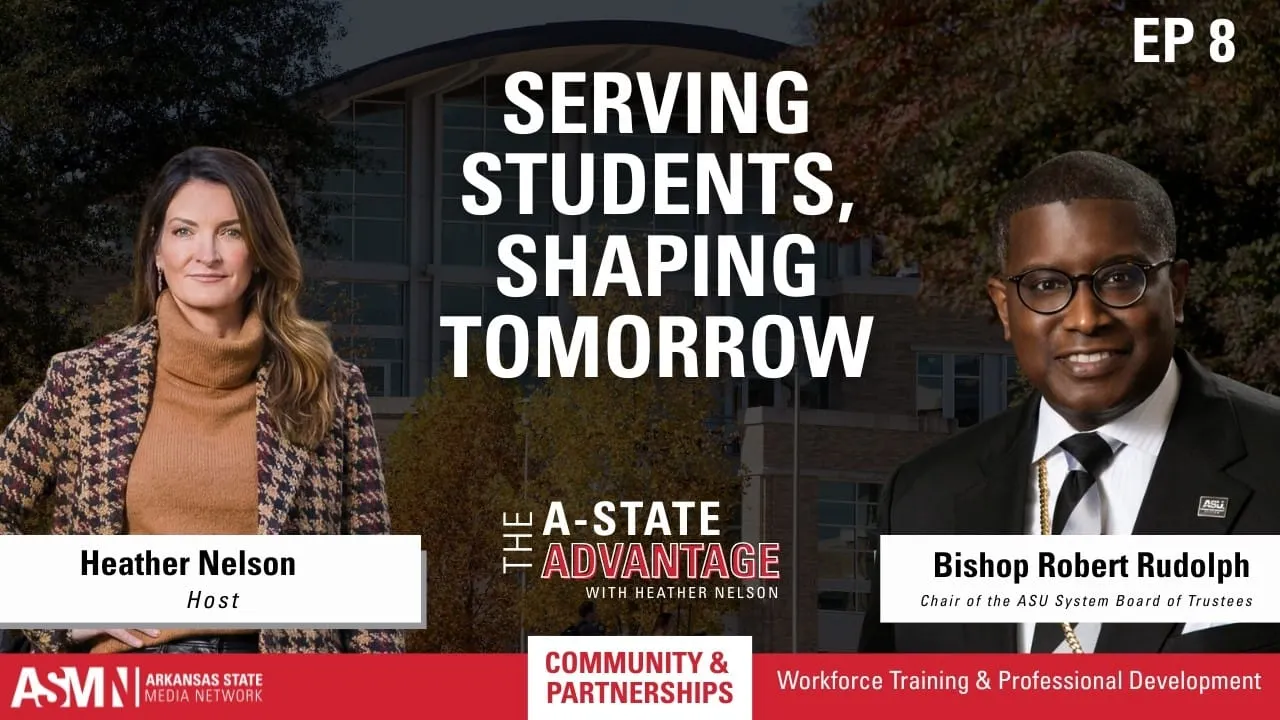
Decisions made in a university boardroom today will dictate the workforce and economy of a state twenty years from now. With higher education facing rapid shifts in technology, student needs, and financial viability, understanding who steers the ship has never been more critical. Bishop Robert Rudolph, Chair of the Board of Trustees for the ASU system, joins us to unpack the weight of managing public trust across seven distinct institutions.
We get into the mechanics of university governance, from navigating complex system searches for a new president to understanding the unique cultural demands of different regional campuses. We dissect the contrast between the college experience of the past and the immediate, technology-driven needs of today's students. Bishop Rudolph shares his core philosophy on leadership: that true governance requires stepping out of the boardroom and walking into the campus cafeteria unrecognized to hear exactly what the end customer is experiencing.
The reality of serving as a trustee requires far more than an occasional ceremonial meeting. We discuss the heavy burden of combing through hours of budget files and the pressure of stepping in when a historic campus is on the verge of financial collapse. You will walk away with a clear framework for making decisions that outlast your tenure and an understanding of how to balance immediate operational emergencies with decades-long strategic vision.
If you care about higher education administration, long-term strategic planning, and servant leadership, you’ll get a lot from this. Please subscribe to the channel and share this episode with anyone interested in the mechanics of public institutions. What is the hardest long-term leadership decision you are having to navigate right now?
@Arkansasstatemedianetwork.com.
More About this Episode
Why University Board Governance Is the Missing Link in Modern Higher Education: Inside the ASU System with Bishop Robert Rudolph
If you ask the average citizen, business owner, or even local student who is actually running their regional university, you will usually hear names like the President, the Chancellor, or maybe a high-profile athletic director. Very rarely will someone point to the Board of Trustees. Yet, misunderstanding the role of a university board can leave communities completely disconnected from the decisions shaping their local workforce, economic future, and institutional stability. Right now, higher education is undergoing massive shifts in student retention, digital access, demographic cliffs, and state funding models. In this high-stakes environment, transparent governance is more critical than ever before.
On this episode of the Arkansas State Media Network, we sat down for an extensive, deeply insightful conversation with Bishop Robert Rudolph, Chair of the Arkansas State University (ASU) System Board of Trustees. Bishop Rudolph brings a fascinating, multidimensional perspective to institutional oversight, blending over three decades of public service, executive church leadership, and state-level government experience. As someone who once walked the campus of Henderson State University as Student Government Association President and now guides the policy trajectory of seven distinct campuses across our state, he understands the delicate balance between high-level governance and the daily lived experience of students.
If you have ever wondered how a university system with a multi-million dollar budget operates, how trustees handle crisis financial management, or how regional campuses maintain their unique identities under one corporate umbrella, this discussion is essential reading. Let's examine the core mechanics of system-level decision-making and what effective public sector leadership really looks like from the top down.
From Student Body President to Board Chair: The Philosophy of Service
To understand how Bishop Rudolph approaches his role on the ASU System Board of Trustees, you have to understand where he started. Long before he was consecrated as a bishop in the Church of God in Christ or advised governors at the Arkansas State Capitol, he was an undergraduate student at Henderson State University in Arkadelphia. Serving two terms as SGA President gave him a foundational, front-row seat to how administrative policy directly impacts student morale, academic progression, and campus life.
When Governor Asa Hutchinson appointed him to the expanded ASU System board back in 2021—shortly after Henderson State officially merged into the system—it was a full-circle moment. But transitioning from a student advocate to a board trustee requires a significant shift in perspective. A trustee is a fiduciary, a guardian of public trust, and a strategic planner tasked with looking five, ten, and twenty years down the road.
During our conversation, Bishop Rudolph emphasized that governance is fundamentally about servant leadership. Trustees are volunteer citizens; they do not receive a salary for the heavy, uncompensated hours they spend reviewing dense fiscal audits, legal briefs, and master plans. They do it out of a profound obligation to the state and its students. For Rudolph, his extensive background as an Adjutant General and Governmental Affairs Liaison in ministry taught him how to navigate complex bureaucratic structures while keeping human empathy at the forefront. That synthesis of rigorous administrative protocol and pastoral care is what defines his tenure as Chair.
The Unseen Mechanics of System Oversight and the "Dining Hall Philosophy"
One of the most fascinating segments of our interview centered on how a board actually gathers accurate data to make decisions. In corporate governance and higher education alike, board members are typically fed information through highly polished presentations, curated slide decks, and official executive summaries prepared by campus administrators. While these reports are vital for tracking macro-level metrics, they can sometimes act as a filter, insulating trustees from the ground-level reality of the campus ecosystem.
To break through that administrative filter, Bishop Rudolph relies on what we might call his "dining hall philosophy." Whenever his schedule permits, he makes unannounced, informal visits to the common areas, student unions, and dining halls across our seven campuses. He grabs a tray, sits down among undergraduate students, andSimply listens.
Why go through this extra effort? Because you cannot truly understand student retention strategies or digital access barriers from a spreadsheet alone. Sitting in a dining hall allows a trustee to observe the daily student experience in real-time. Are the facilities well-maintained? Are students talking about how hard it is to get an appointment with an academic advisor? Is there an energy of optimism on campus, or is there underlying frustration regarding resources? By pairing raw, unfiltered qualitative data from students with formal quantitative reports from chancellors, the Board of Trustees can make nuanced policy decisions that address actual, pressing student needs rather than theoretical problems.
Governing Seven Distinct Campuses: Balancing Unity with Regional Autonomy
A common misconception about multi-campus university systems is that they operate like a corporate franchise, where every location is forced into an identical mold. In reality, the Arkansas State University System is a diverse ecosystem comprising seven unique member institutions, ranging from our comprehensive R2 flagship research university in Jonesboro (A-State) to vital two-year regional institutions like ASU-Beebe, ASU-Newport, ASU-Mountain Home, ASU Mid-South in West Memphis, and ASU Three Rivers in Malvern.
A major challenge for the Board of Trustees is determining where system-wide consolidation makes sense and where campus culture differentiation must be fiercely protected. Bishop Rudolph noted that the demographic and economic realities of West Memphis are entirely different from those in Mountain Home or Arkadelphia. A one-size-fits-all administrative approach would be disastrous for regional development.
Instead, effective system governance operates on a principle of strategic alignment and operational empowerment:
- System-Level Centralization: The Board and System President handle macro-level efficiencies—such as legal counsel, government relations, bonding authority, high-level administrative software, and overarching policy frameworks. This saves taxpayers and students money by eliminating administrative redundancies across campuses.
- Campus-Level Execution: Individual Chancellors and campus leadership teams are granted the autonomy to tailor their academic programming, student outreach, and campus culture to the specific needs of their local communities.
When trustees evaluate new degree programs or capital improvement projects, they do so through the lens of regional impact. How does this specific campus serve its immediate geographic footprint? The board's role is not to micromanage daily operations, but to ensure that each campus has the resources, accountability structures, and strategic direction necessary to thrive in its specific lane.
Navigating Turnarounds: The Reality of Financial Intervention at Henderson State
You cannot talk about modern higher education governance without addressing the harsh fiscal realities facing regional universities nationwide. Declining birth rates, shifting cultural perceptions of college degrees, and rising operational costs have pushed many historic institutions to the brink of insolvency. The ASU System faced this reality head-on during the financial intervention and restructuring of Henderson State University.
When Henderson State merged into the ASU System, it brought a storied history of academic excellence—and a severe, structural financial crisis that required immediate, painful remediation. For volunteer trustees, guiding an institution through financial stabilization is an immense logistical and emotional weight. It involves poring over dense budgets, making heartbreaking decisions regarding program viability, and facing intense public scrutiny from alumni, faculty, and community members who care deeply about their alma mater.
Bishop Rudolph spoke with candid vulnerability about what it takes to govern through a turnaround of this magnitude. It requires a steadfast commitment to long-term survival over short-term popularity. Fiduciary duty means asking tough questions: Are our instructional resources aligned with our revenue? Are we subsidizing underenrolled programs at the expense of institutional solvency?
The stabilization of Henderson State serves as a realistic framework for handling high-stakes public accountability. By implementing rigorous financial controls, data-driven academic scheduling, and transparent reporting, the board helped step Henderson back from the financial ledge. The lesson for governance leaders everywhere is clear: true stewardship sometimes requires radical transparency and difficult structural restructuring to ensure that a university can keep its doors open to educate the next generation of students.
Aligning Higher Ed with the Workforce Development Continuum
Why does all of this system-level governance matter to the average citizen or local business owner who hasn't stepped foot on a college campus in decades? Because universities are the primary engine of regional economic survival.
Throughout our conversation, Bishop Rudolph repeatedly framed higher education not as a siloed academic bubble, but as the foundation of the local workforce development continuum. Today's university system must be intimately connected to the needs of industry, healthcare, agriculture, and technology within the state.
When the Board of Trustees approves a new technical certificate at a two-year campus or authorizes a major capital expenditure—like the groundbreaking College of Veterinary Medicine at A-State—they are directly responding to workforce deficits. They are asking: What are the primary barriers preventing local industries from expanding? What skills will our high school graduates need five years from now to secure high-wage jobs without having to leave their home state?
Effective governance bridges the gap between educational policy and economic realities. Whether it is expanding nursing cohorts to combat rural healthcare shortages, investing in digital infrastructure to support remote learning, or building advanced manufacturing pathways at our two-year campuses, the board ensures that public dollars are being invested in programs that yield tangible socioeconomic returns for our communities.
The Future of Public Trust and Institutional Leadership
As we look toward the future of higher education, the speed of decision-making and the preservation of public trust will be the defining metrics of successful boards. We live in an era where institutional trust is eroding across the public sector. To counteract this trend, university boards must operate in the light, demonstrating clear ethical standards, fiscal conservatism, and an unwavering focus on student outcomes.
Bishop Rudolph's journey reminds us that effective leadership at the executive board level requires a dual focus: you must keep your eyes fixed on the horizon of long-range strategic vision, but you must also keep your feet firmly planted on the pavement of the student experience. By combining rigorous financial oversight with human-centered empathy—and by never being too busy to sit down in the campus dining hall—trustees can build sustainable, resilient educational institutions that truly serve the public good.
What are your thoughts on the future of higher education governance? As our university systems adapt to changing workforce needs and economic pressures, what is the most important quality you look for in the institutions and leaders shaping the future of your local community?
We want to hear your perspective! Join the conversation by leaving your thoughts in the comments below, and don't forget to subscribe to the Arkansas State Media Network for more in-depth discussions with the leaders shaping our state. Connect with our team directly at @arkansasstatemedianetwork.com.