
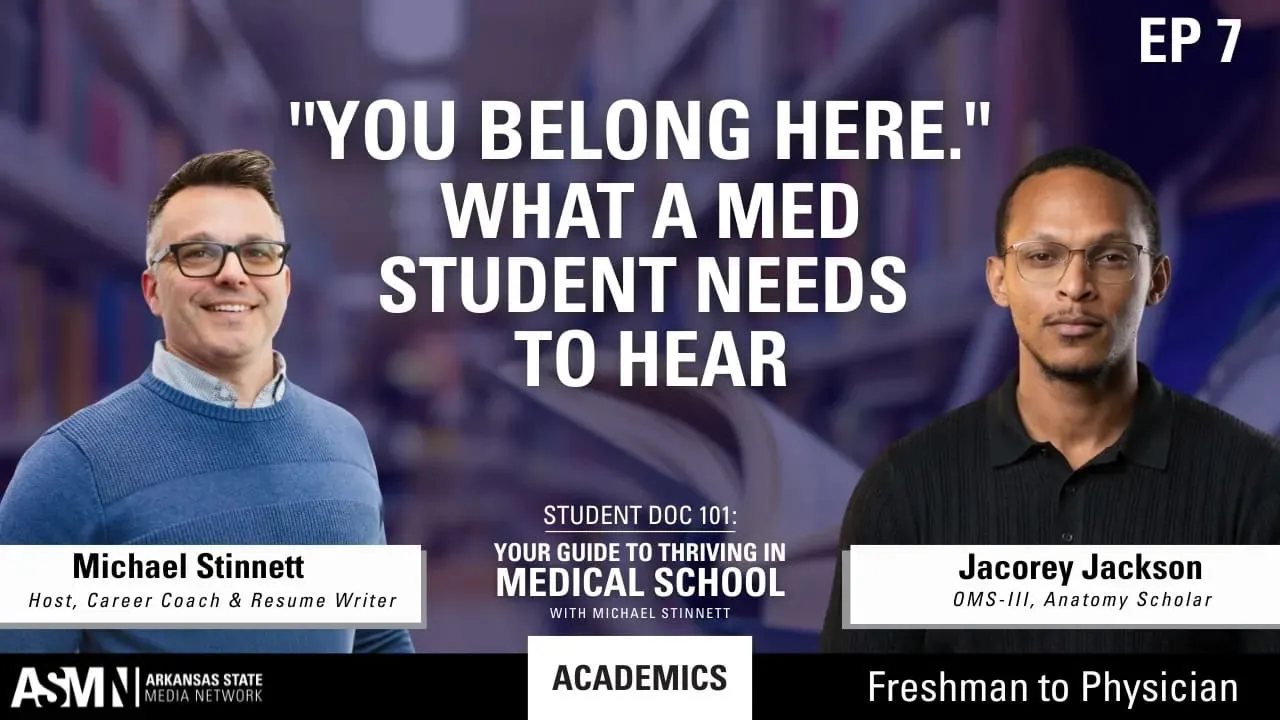
Medical school will push you into panic mode if you let it. When adrenaline spikes and the heavy workload hits, the first things students usually throw overboard are sleep, nutrition, and exercise, the exact habits required to keep the brain functioning under pressure. This conversation is about stopping that desperation cycle before it starts so you can actually thrive during four grueling years of education. We sit down with medical student and former Division III college athlete Jacorey Jackson to break down how he applies a rigorous athlete's mindset to the daily demands of medical school.
We get into the direct connection between aerobic exercise and cognitive performance, examining why a physical workout is actually vital for study time for your nervous system. Jacorey shares how he transitioned from civil engineering spreadsheets to biochemistry, the trial-and-error process of scheduling study blocks around non-negotiable gym time, and how to avoid the trap of the sympathetic nervous system stress response. We also dig into the surprising level of peer cooperation in medical cohorts and how to handle social media algorithms designed to steal your focus with instant gratification. The secret sauce of his approach lies in treating well-being as a strict operational boundary rather than a luxury, ensuring you never sacrifice the physical machine that drives your mental output.
The hardest part of this journey isn't just memorizing the vast volume of material; it is fighting the urge to self-isolate and double down when you hit an academic wall. When grades drop or a concept won't stick, high achievers naturally want to beat their heads against the desk for hours instead of doing the difficult work of stepping away to reset. You will walk away from this conversation with a practical framework for setting daily boundaries, a reality check on why asking for help is a sign of resilience rather than weakness, and a counterintuitive strategy for incoming students that involves doing zero academic prep before day one.
If you care about cognitive performance, sustainable study habits, and maintaining your identity under intense pressure, you’ll get a lot from this. Hit the subscribe button to follow our ongoing guide to thriving in medical school, and share this episode with a classmate or future student who needs a reminder to step away from the desk. What is one non-negotiable daily habit you refuse to sacrifice for your studies or career? Let us know in the comments below.
@arkansasstatemedianetowrk.com.
More About the Episode
How to Thrive in Medical School: Mastering Mindset, Well-Being, and Academic Success
By Michael Stinnett, Medical Education Learning Specialist
There is a pervasive myth surrounding medical education that has gone unchallenged for far too long. Society paints medical school as a four-year gauntlet of chronic sleep deprivation, profound isolation, and unrelenting personal sacrifice. Students entering their first year often believe that suffering is a mandatory prerequisite for becoming a capable physician.
Let us be completely honest about the reality of the situation. Medical school is undeniably hard. The volume of information is immense, the pacing is relentless, and the expectations are exceptionally high. However, there is a profound difference between experiencing a challenging academic environment and living in a constant state of suffering. You do not have to abandon your well-being, your identity, or your sanity to earn your degree. With the right strategies, boundaries, and mindset, you can do more than simply survive medical school. You can truly thrive.
As a medical education learning specialist, I work daily with high-performing students who navigate these exact pressures. By examining the habits of those who flourish both academically and personally, we can uncover a clear blueprint for success. This guide explores the foundational practices that will protect your mental health, optimize your cognitive learning, and help you build a sustainable medical career.
The Trap of Desperation and the Abandonment of Self-Care
When students first encounter the sheer volume of medical school coursework, their initial reaction is almost universal. They experience a deep sense of desperation. When exam deadlines loom and practice test scores feel precarious, the human brain enters a state of panic. In this sympathetic nervous system fight-or-flight response, decision-making capabilities degrade rapidly.
Driven by desperation, students immediately begin looking for hours they can reclaim in their day. Almost without fail, the very first things they throw overboard are the core pillars of human well-being: exercise, healthy nutrition, adequate sleep, and meaningful social interaction. Students convince themselves that they do not have time to go to the gym, prepare a nutritious meal, or sleep eight hours a night. They believe that sitting at a desk for twelve uninterrupted hours is the only way to prove their dedication and improve their scores.
This is a catastrophic miscalculation. You are a human being first, and a medical student second. When you systematically strip away the activities that keep your mind and body healthy, your cognitive performance inevitably collapses. You cannot expect peak mental performance from an exhausted, isolated, and under-fueled body.
The Cognitive Power of Aerobic Exercise
Of all the healthy habits students abandon under pressure, physical fitness is typically the first to go. Many view exercise as a luxury item on their daily to-do list, something to be pursued only if there happens to be leftover time at the end of the day.
To understand why this approach is flawed, we have to look at the science of cognitive learning. In the landmark educational text The New Science of Learning by Terry Boyle and Todd Zakrajsek, researchers point to a powerful connection between physical activity and brain function. The authors note that aerobic exercise is arguably the single most important activity you can engage in to enhance cognitive learning, memory consolidation, and overall brain performance.
When you go for a run, lift weights, or engage in cardiovascular training, you are not taking time away from your academic preparation. You are actively optimizing your brain to process, retain, and recall complex medical science. Physical training reduces cortisol levels, increases blood flow to the prefrontal cortex, and stimulates the release of neurotrophic factors that build new neural pathways.
If physical fitness was a core part of your identity before medical school, making it non-negotiable during your training is essential. Whether you were a student-athlete, a runner, or a casual gym-goer, that physical outlet is a vital stress management tool. Making well-being non-negotiable is not a sign of academic weakness. It is a strategic advantage for high-level learning.
Intentional Boundaries and the Science of Time Management
A common excuse among struggling students is that there simply are not enough hours in the day to study, exercise, sleep, and maintain a personal life. Yet, every medical student operates within the exact same twenty-four-hour daily window. The difference between those who burn out and those who flourish lies in intentional time management and personal boundaries.
You do not simply find time for self-care in medical school. You must actively make time for what is genuinely important in your life. This requires establishing strict, non-negotiable boundaries between your academic responsibilities and your personal life. When it is time to study, you must be fully present and focused, eliminating distractions to maximize your efficiency. Just as importantly, when that dedicated study block ends, you must step away from the desk without guilt.
Finding a daily schedule that works for your unique biological clock requires patience and conscious trial and error. Some students thrive by completing their hardest tasks, such as intense physical workouts or challenging practice questions, at four in the morning. Others discover that morning exams disrupt their routine, prompting them to shift their physical training and deep review sessions to the late afternoon or evening.
Do not be afraid to experiment with your routine until you find a sustainable rhythm. Remember that concrete actions create real outcomes, whereas passive wants produce nothing. If you want a balanced life in medical school, your daily schedule and calendar must clearly reflect those priorities.
From Cutthroat Competition to Collaborative Learning
Before arriving on campus, many incoming students harbor a secret dread that medical school will be a cutthroat academic dogfight. They imagine an environment where peers hoard study guides, refuse to share notes, and actively work to undermine one another to secure the top spot in the class ranking.
While medical school is certainly filled with competitive, high-achieving individuals, the most successful students quickly realize that isolation is a direct path to failure. The sheer scope of medical knowledge is too vast for any single person to master entirely in isolation. The students who thrive are those who actively reject the competitive mindset and intentionally build a collaborative learning community.
When you struggle with a difficult concept or experience a disappointing exam grade, your ego will naturally want to retreat. High achievers are accustomed to excelling, and falling short of personal perfection can trigger intense self-doubt. When you isolate yourself during these low moments, you fall into a vicious cycle of anxiety and over-studying.
To survive and advance, you need peers who are willing to get down into the trenches with you. You need study partners who will stay up late quizzing you on complex pharmacology, explain difficult physiological mechanisms with patience, and hold you accountable when you begin feeling sorry for yourself. Medical school is a team sport. Cultivating cooperation over competition will not only improve your grades but will also save your mental health.
The Strength of Asking for Help and Embracing Desirable Difficulties
One of the greatest psychological hurdles for high-achieving students is learning how to ask for help. Most individuals admitted to medical school have a lifelong track record of academic excellence. They are accustomed to solving difficult problems independently, often serving as the person others turn to for tutoring and guidance.
Consequently, when these students finally encounter academic material that does not immediately click, they often view needing assistance as a profound personal failure. They spend three or four hours stubbornly beating their heads against a single concept, feeling increasingly frustrated and inadequate as they watch their peers grasp the material with apparent ease.
We must completely reframe how we view vulnerability in academic settings. Asking for help is not a sign of intellectual weakness. In fact, being unable or unwilling to ask for assistance is the true weakness. Realizing your personal limitations and utilizing the robust support structures available on campus, such as learning specialists, faculty office hours, and peer tutoring services, is a hallmark of maturity and professional strength.
Part of this maturation involves understanding the concept of "desirable difficulties" in learning. Cognitive scientists have proven that learning which feels challenging and requires significant effort is ultimately much more durable. This is precisely why medical students must transition away from simple, first-order recall notes and embrace difficult, board-style practice questions. The productive struggle of working through complex clinical vignettes builds lasting neural pathways. However, there is a critical distinction between productive cognitive struggle and pointless, isolated frustration. When you reach a wall, have the discipline to step away, reset your perspective, and ask a colleague or specialist for guidance.
Overcoming Comparison and the Social Media Trap
In our hyper-connected modern world, maintaining focus requires actively guarding your mental space against external distractions. Social media algorithms are engineered to capture your attention by selling instant gratification and seemingly effortless solutions. In the medical school ecosystem, this manifests as endless advertisements for miracle AI study tools, shortcut guides, and curated feeds of peers who appear to be living perfect, stress-free lives while scoring in the ninety-ninth percentile.
We must recognize social media for what it often becomes: a notorious thief of joy. When you scroll through feeds highlighting the academic triumphs and leisurely highlights of others, it is natural to feel inadequate about your own unseen struggles. You begin comparing your behind-the-scenes reality to someone else's carefully edited highlight reel.
If you want to thrive, you must stop looking sideways and commit to running your own race. The trajectory of your medical career has nothing to do with the pace or strengths of the student sitting next to you. Everyone possesses unique cognitive strengths and inevitable weaknesses. Someone else's rapid mastery of neuroanatomy does not diminish your inherent capability or your future effectiveness as a physician. Focus entirely on your personal daily progress, celebrate your incremental victories, and ignore the noise of constant digital comparison.
Preparing for Day One: The Secret of Doing Nothing
Every year, eager incoming medical students ask what academic materials they should study during the summer before their first semester. They ask if they should pre-read anatomy textbooks, enroll in biochemistry refresher courses, or begin flashcard decks months in advance.
My answer to this question is always the same, and it almost always catches them by surprise. The best academic preparation you can do before starting medical school is to do absolutely nothing academic at all.
Do not spend your final summer cramming complex science into your brain. Instead, dedicate those months to taking care of yourself as a human being. Spend quality time with your family, invest in deep conversations with close friends, travel, read fiction, and pursue the hobbies that bring you genuine happiness.
From the exact moment you step onto a medical school campus for orientation, your baseline adrenaline and cortisol levels will naturally begin to rise. The inherent rigor of the curriculum will keep you challenged for the next four years, straight into residency. Why would you do yourself the disservice of entering that demanding environment already stressed, exhausted, and operating at maximum capacity? Arrive on day one as relaxed, healthy, and grounded as humanly possible. Protect your baseline peace so that you have the emotional and physical reserves required to handle the bumpy ride ahead.
Anchoring to Your Purpose: Remembering Your "Why"
No matter how intelligent, disciplined, or well-prepared you are, there will be days in medical school when you get knocked down. You will face disappointing exam results, exhausting clinical rotations, and moments of profound intellectual fatigue. When you feel completely depleted and the thought of giving up crosses your mind, you must have a powerful internal anchor to hold you steady.
You must remember your "why."
Long before you sat in a medical school lecture hall, you wrote a personal statement explaining to admissions committees why you wanted to dedicate your life to the service of others through medicine. That foundational motivation is your internal seed. It represents the catalyst that started you on this long, rigorous path and reminds you of the future impact you want to make on the lives of your patients.
When the daily grind of medical education leaves you feeling battered and bruised, revisit that foundational purpose. Keep a physical reminder of your goals on your desk or in your locker. Connect with the human element of medicine by volunteering, talking to mentors, or reflecting on the patients who are waiting for someone with your exact empathy and dedication to heal them.
The Undeniable Truth: You Belong Here
If you take only one message away from this guide, let it be this fundamental truth: You belong here.
Medical school admissions committees do not hand out acceptances by accident or luck. The application process is rigorously designed to identify individuals who possess both the intellectual fortitude and the emotional resilience required to become physicians. If you are sitting in a medical school classroom, you have already earned your seat.
Never allow a difficult exam, a struggling study session, or a challenging interaction with a professor to convince you that you are an imposter. You have survived every difficult academic obstacle placed in your path thus far, and you possess the capacity to master this curriculum as well.
By making your physical health non-negotiable, setting clear personal boundaries, leaning on collaborative peer networks, and courageously asking for help when you need it, you will navigate the rigors of medical school with confidence. Take care of yourself, support the peers running alongside you, and trust in your ability to succeed. You belong here, and the medical field is waiting for the extraordinary physician you are working so hard to become.