
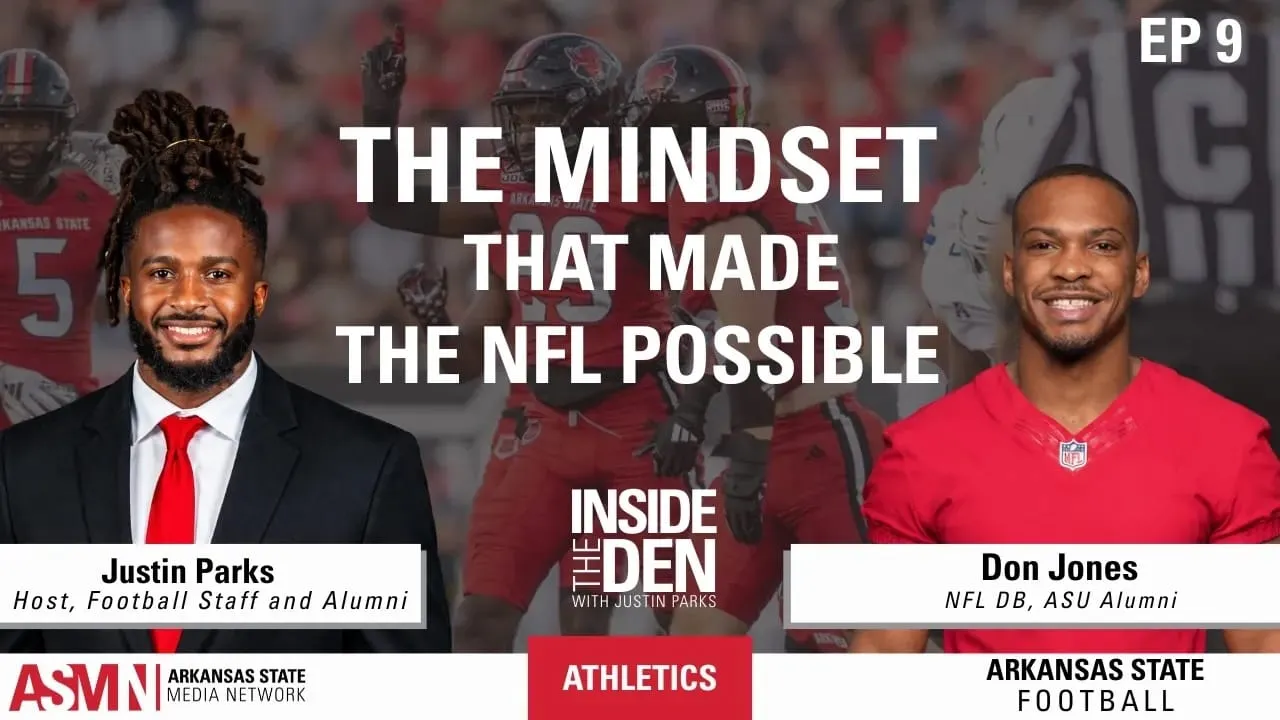
Breaking into professional sports requires far more than raw athletic ability. Thousands of college athletes spend their lives mastering a single position, only to discover that staying at the highest level demands total adaptability. When schemes change, roster limits, and physical demands align, the players who survive aren't just the fastest; they are the ones willing to switch roles, swallow their pride, and excel where others won't. We sit down with 7-year NFL veteran and Arkansas State legend Don Jones to break down his journey from running back to defensive back, navigating junior college, and earning a spot in the NFL Draft.
We get into the technical realities of transitioning from an offensive mindset to a reactive defensive position, the exact 40-yard dash metrics scouts prioritize, and what it was like studying film alongside Bill Belichick, Tom Brady, and Rob Gronkowski. Don breaks down how locking in on special teams coverage became his primary strategy for maintaining a spot on an active roster for seven seasons. He also shares how film study separates instinctual players from true long-term professionals in the league.
Earning a living in professional football requires an upfront understanding of your physical limits and a concrete plan for the future. Stepping away from the structure of team sports often leads to identity loss, mental health struggles, and an abrupt shift in daily routine. Navigating that transition successfully comes down to prioritizing mental health through therapy, finding a passion outside of athletics, and building a sustainable lifestyle before your playing career ends.
If you care about college football recruiting, NFL draft preparation, and navigating life transitions after sports, you’ll get a lot from this episode. Please subscribe and share this show with someone who needs to hear it.
What is the biggest operational lesson you've taken from an athlete who successfully transitioned into their second career? Let us know in the comments below!
@arkansasstatemedianetwork.com
More About this Episode
From Arkansas State Football to a Seven Year NFL Career: Lessons in Adaptability and Resilience
When you look back at the history of Arkansas State football, certain names stand out as pillars of the program. These are the guys who laid the foundation for the success we see today and set a standard of excellence that every current player strives to match. As a former player and current coach here at Arkansas State, I constantly look to our alumni to show our young athletes what it takes to reach the pinnacle of the sport. One of those legendary figures is Don Jones, a guy who carved out an incredible seven year career in the National Football League through sheer grit, unmatched athleticism, and a willingness to do whatever it took to stay on the field.
The journey from college football to the NFL is never a straight line. It is filled with obstacles, unexpected position changes, and a mental grind that tests even the strongest athletes. Exploring the path of a player who transitioned from a college running back to an NFL safety provides a blueprint for survival in professional football. It is a story about embracing change, mastering the details of the game, and finding a sense of purpose when the stadium lights finally turn off.
The Art of the Position Change
Athleticism is the price of admission in college football, but adaptability is what keeps you on the roster. Many fans do not realize that some of the best defensive players in the world started their careers with the ball in their hands. The transition from running back to defensive back is one of the most difficult moves a player can make on the gridiron. As a running back, you are dictating the action. You decide when to cut, when to accelerate, and where to attack the defense. As a defensive back, you are entirely reactive. You have to backpedal, read the hips of a receiver, press at the line of scrimmage, and make split second decisions while moving backward.
Making that leap requires intense physical tools and incredible mentorship. When a player possesses a 46 inch box jump and runs a 4.3 in the 40 yard dash, the raw materials are there. But raw talent only gets you so far. The secret to a smooth transition lies in the training and the people you surround yourself with during the offseason. Working with established veterans who have already navigated the NFL landscape can shave years off a young player's learning curve. Mastering the footwork, the backpedal, and the transition out of breaks is a tedious process. Having a mentor who played in the league to guide those drill sessions is the difference between looking lost on the field and looking like a natural born safety.
A Championship Pedigree
Building a winning culture takes time, but once that momentum gets rolling, it becomes a force of nature. During his time at Arkansas State, the program experienced some of its most historic moments under the leadership of legendary coaches like Gus Malzahn and Hugh Freeze. These coaches brought SEC level expectations to the program, teaching the players how to come together to win and showing them exactly what it takes to be champions.
One of the most defining moments of that era was walking into College Station and beating Texas A&M in front of 100,000 screaming fans. That kind of victory changes the DNA of a football program. It proves that when you have the right scheme, elite strength and conditioning, and a locker room full of guys who refuse to back down, you can compete with anyone in the country. Winning Sun Belt Conference championships became the standard. The strength and conditioning staff played a massive role in that success, elevating the players physically and keeping them healthy through the grueling gauntlet of a college football season.
Decoding the NFL Draft Process
When the college career wraps up, the focus immediately shifts to the NFL draft process. For players dreaming of hearing their name called, the preparation phase can be a rude awakening. College film is incredibly important, but the reality of NFL scouting often comes down to raw measurables. Scouts are looking for athletic freaks.
The single most important metric for a defensive back trying to make it to the league is the 40 yard dash. It does not matter how many tackles you made or how many interceptions you caught if you cannot prove you have the breakaway speed to run down an elite wide receiver. The NFL is a speed league. When you get to the combine or your pro day, every scout in attendance is holding a stopwatch, waiting to see if you can break that 4.4 threshold. You have to put good stuff on film, but if you want to get your foot in the door, you have to spend your offseason perfecting your start, your drive phase, and your top end speed for those 40 yards.
Surviving and Thriving in the National Football League
Getting drafted is a dream come true, but staying in the league is a completely different monster. The phrase "Not For Long" is a harsh reality in professional football. We see first round draft picks wash out of the league in two years, while undrafted free agents carve out decade long careers. The biggest transition from college football to the NFL is not the physical speed of the players, but the mental speed of the game.
NFL players are incredibly smart. The level of film study required to survive in the pros is staggering. In college, you can often rely on pure instinct and natural athleticism to make plays. In the NFL, everyone is fast and everyone is strong. The guys who stick around are the ones who study their opponents relentlessly. They know the offensive tendencies based on down and distance, they recognize formations instantly, and they play faster because they have a mental blueprint of the play before the ball is even snapped.
For a young player trying to secure a roster spot, the path to longevity almost always runs through special teams. You have to find a way to bring value to the organization every single week. If you are not a starting safety, you better be the fastest gunner on the punt team or the most physical blocker on the kickoff return unit. Embracing a role on special teams is how you build trust with the coaching staff. It shows that you are willing to do the dirty, unglamorous work to help the team win.
The Masterclass of Bill Belichick
Playing for the New England Patriots offers a masterclass in situational football. Sharing a locker room with legends like Tom Brady and Rob Gronkowski is an unforgettable experience, but the true education comes from the meeting rooms. Coach Bill Belichick is famous for his meticulous attention to detail. Every morning, he would stand in front of the team for an hour, breaking down film with surgical precision.
He would pull up tape from an AFC Championship game played five years prior just to show how a single, undisciplined penalty cost a team a trip to the Super Bowl. He would point out specific weaknesses in opposing players, noting that a particular defensive end playing linebacker had no ability to cover in space. That level of preparation trickles down to every man on the roster. When you see exactly how a minor mistake can ruin a season, you make sure you never make that mistake on Sunday.
The Weekly Grind and Body Maintenance
The NFL schedule is a structured routine designed to maximize performance and recovery. While college players only have a few hours a day dedicated to football due to academic obligations, the NFL is a full time job. A typical in season week involves heavy lifting on Mondays to flush out the body, film review, and walkthroughs. Wednesdays and Thursdays are the grind days, filled with meetings from eight in the morning until five in the evening, sandwiched around intense practices. Fridays are lighter walkthroughs, and Saturdays are for travel.
With all that free time outside the facility, the great ones invest heavily in their bodies. Your body is your money maker in professional football. If you are constantly injured, you will get cut. That means spending hours getting massages, stretching, and doing recovery work. While some guys prefer the traditional, freezing misery of the cold tub, others lean toward the modern efficiency of cryotherapy. Whatever the method, taking care of your physical health is a non negotiable part of being a professional.
Tackling Life After Football and Mental Health
Eventually, the game ends for everyone. Whether you play one year or ten years, the transition away from professional football is one of the most challenging periods in an athlete's life. For years, your entire identity is tied up in a helmet and shoulder pads. You wake up with a schedule, a team, and a singular purpose. When that is suddenly gone, the silence can be deafening.
Many former players struggle deeply with this transition. The lack of a daily routine and the loss of locker room camaraderie can lead to anxiety, crankiness, and severe depression. It is a postpartum experience that is rarely talked about in sports media. The most important thing a former athlete can do is put their pride aside and ask for help. There are rehabilitation programs specifically designed for former NFL players to help them navigate this massive life change. These programs provide a space to talk through the struggles, figure out who you are outside of football, and build a roadmap for the rest of your life.
Finding a new passion is the key to surviving life after football. You have to find a hobby or a business that gives you a reason to get out of bed in the morning. For some, it is coaching. For others, it is building old cars. For Don Jones, it was returning to his roots and building a massive farm.
What started as a plan to buy a few cows during his playing days eventually transformed into a sprawling stable of horses, goats, and chickens. Running a farm and hosting trail rides provides a daily schedule, physical labor, and a connection to nature that replaces the chaos of the gridiron. It keeps the mind occupied and prevents the trap of endlessly scrolling through social media comparing your life to others. Comparison is the biggest thief of joy. Finding a new purpose allows a former player to leave the game behind and step confidently into the next chapter of their life.
Final Advice for the Next Generation
For the young guys currently grinding it out at Arkansas State, the blueprint for success is laid out right in front of you. If you want to make it to the next level, you must remain entirely coachable. You will never know it all. The guys who last in the NFL are the ones who stay after practice to ask the coaches how they can refine a specific technique or cheat a specific coverage.
More importantly, you have to find your "why." If you do not have a deep, foundational reason for why you play this game, the sport will eventually expose you. You have to love the process, love the grind, and love the feeling of sprinting full speed every single time you cross those white lines. Bring your own energy to the facility every day, lead by example, and never take a single rep for granted. The path from Jonesboro to the NFL is real, but it requires a level of dedication that most people are simply not willing to give.