
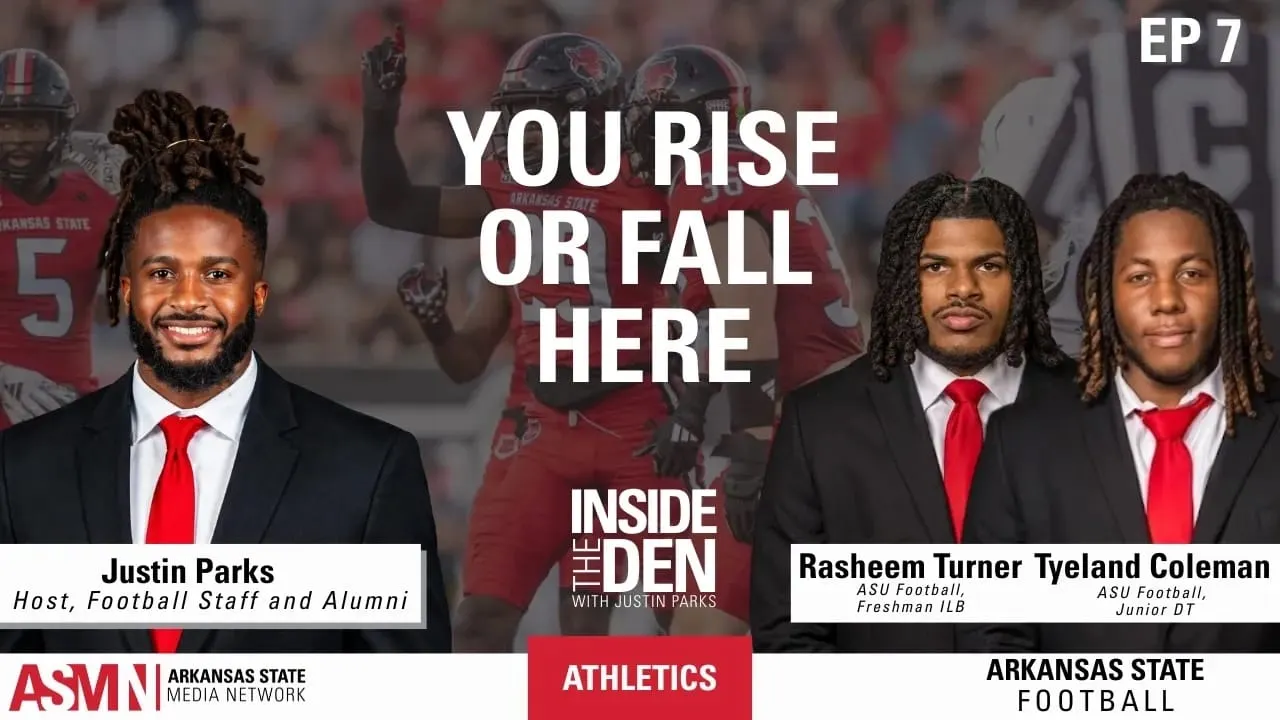
Falling behind in summer conditioning is a quick ticket to the sideline. As college football rosters become completely overhauled year after year through the transfer portal, establishing a new standard early is the only way to survive. Defensive tackle Tylen Coleman and freshman linebacker Rashem Turner share their distinct paths to the Arkansas State gridiron.
We sit down to break down the shock of D1 summer workouts and the massive jump in speed from Friday nights to Saturday afternoons. The conversation spans the nuances of JUCO transfers versus early high school enrollees, navigating the chaotic landscape of modern recruiting, and the mental shift required to balance defensive schemes with Canvas deadlines. The core takeaway is that raw athletic talent only gets you so far without a rigid routine that holds you accountable for the smallest daily habits.
The college lifestyle is incredibly demanding, and the sheer volume of early mornings, intense practices, and late-night study sessions can easily break a player who isn't adequately prepared. Listeners will walk away with a clear understanding of the sacrifices required at this level, learning why pacing yourself, staying ahead of academic deadlines, and relying on the brotherhood of your teammates are vital to staying above water.
If you care about college football recruiting, building a resilient mindset, and the day-to-day execution of a student-athlete, you’ll get a lot from this. Make sure to subscribe to the Arkansas State Media Network and share this episode with anyone looking to elevate their game. What small daily habit has been the most critical to your own success?
@arkansasstatemedianetwork.com
More About this Episode
The Unseen Reality of College Football: Summer Conditioning, Recruiting Roller Coasters, and Building Brotherhood at Arkansas State
By Justin Parks
When fans see college football on game day inside Centennial Bank Stadium, they see the finished product. They see the energy, the lights, the clean uniforms, and the celebrations after a crucial fourth-quarter stop. What gets hidden from public view is the daily, unrelenting grind that actually builds a Division I football team. Between the end of spring ball and the kickoff of the regular season lies the most critical phase of player development: summer conditioning.
For athletes competing in Arkansas State football, the summer months are where physical limits are tested and mental standards are forged. Whether a player arrives as a battle-tested transfer from the junior college ranks or as a high school early enrollee fresh out of their senior year, the reality of college football hits fast and it hits hard. Surviving and thriving at this level requires much more than raw physical talent. It demands a process-driven mindset, elite time management, a deep commitment to brotherhood, and an understanding that every choice off the field directly impacts performance on the gridiron.
The Summer Grind and the Jump to Division I Intensity
There is no gradual introduction to summer workouts in major college football. When players step onto the turf for those initial conditioning sessions, the tempo is designed to test preparation, cardiovascular endurance, and mental fortitude. The heat is relentless, muscles ache from heavy weight room sessions, and the standard of effort never drops.
Many recruits ask what truly separates high school football from college football. The honest answer surprises most people: a high school game often moves at the pace of a standard college practice, and in many cases, a typical Tuesday or Wednesday college practice is physically harder than a Friday night high school game. In high school, a superior athlete can often rely on physical advantages to dominate opponents without perfect conditioning or refined technique. At the Division I Football Bowl Subdivision level, every single player on the field was a standout star at their previous school.
When you line up in the trenches against offensive and defensive linemen from talent-rich states like Alabama, Mississippi, Georgia, Florida, and California, average effort gets exposed immediately. To compete at Arkansas State, players must embrace several foundational physical standards:
- Elite Conditioning Over Raw Size: Carrying weight without cardiovascular endurance leads to fatigue in the third and fourth quarters. Defensive linemen and linebackers must be able to run and pursue sideline to sideline without their technique breaking down.
- Speed of Processing: The physical speed of the game increases exponentially, but the mental speed increases even faster. Players must diagnose formations, communicate adjustments, and execute their assignments in a fraction of a second.
- Daily Physical Resilience: Recovery is just as important as the workout itself. Surviving conditioning requires proactive hydration, proper nutrition, and taking care of the body before alarms go off for early morning runs.
Navigating the Modern Recruiting Landscape: JUCO Grinds vs. Early Enrollee Sacrifices
The modern college football locker room is a melting pot of different backgrounds, ages, and paths to Division I athletics. Today's rosters are constructed through three primary avenues: high school recruiting, the transfer portal, and junior college (JUCO) programs. Each path presents its own unique psychological and physical challenges.
The Junior College Path: Humility and Hunger
For players who take the junior college route, like defensive tackle Tylen Coleman, the journey is defined by perseverance and grit. JUCO football is a world away from the glamour of major college athletics. Facilities are often basic, equipment is limited, and players compete with a chip on their shoulder, knowing that nothing is guaranteed. Spending time in a junior college program teaches athletes never to take a Division I opportunity for granted.
When JUCO product athletes arrive at Arkansas State, they bring a distinct maturity and hunger to the defensive line. They understand what it feels like to work in the shadows without recognition. That perspective breeds gratitude for the coaching staff, the nutrition programs, and the strength facilities available in Jonesboro, turning adversity into a driving force for leadership on the practice field.
The Early Enrollee Experience: Growing Up Fast
On the opposite end of the spectrum are high school prospects who make the decision to enroll early, arriving on a college campus in January instead of June. Athletes like freshman linebacker Rashene Turner, coming out of competitive Florida high school programs like Seminole High School, make a massive personal sacrifice by graduating early. They miss out on the traditional second half of their senior year, trading high school proms and graduation ceremonies for 7:30 AM college classes, grueling winter conditioning, and spring football practice.
While the transition is jarring, enrolling early is the single best way for a young player to accelerate their development. Instead of spending their freshman fall trying to learn the playbook while adapting to college life, early enrollees get their "welcome to college" moment out of the way during the spring. They learn how to balance academic course loads, manage their time without parents or teachers constantly looking over their shoulders, and adapt to the intensity of going against veterans who have jobs, families, and future livelihoods on the line.
From the Court and the Backfield to the Defensive Front
Athleticism in college football is rarely linear. Very few players stay at the exact same position from second grade all the way to college. In fact, some of the most dominant defensive players in the country began their athletic journeys carrying the football or playing entirely different sports.
It is common to find defensive tackles who dominated little league football as power running backs before their size and frame naturally shifted them to the defensive line. Having that background as a ball carrier gives defensive linemen a unique understanding of backfield vision, footwork, and leverage. Similarly, linebackers often transition from high school defensive ends or safeties, learning how to drop into coverage while maintaining the physical edge required to take on 300-pound offensive linemen in the box.
Multi-sport athleticism also plays a massive role in player development. Across the roster, from defensive backs to offensive linemen, you will find players who excelled on the basketball court. Basketball develops foot speed, spatial awareness, lateral agility, and hand-eye coordination: traits that translate directly to pass coverage, pass rushing, and open-field tackling. That competitive spirit carries over into locker room debates over which position group would win an intramural basketball tournament, though when the games turn to full-court transition, the defensive backs and skill players usually take the advantage over the big men on the line.
The Power of Brotherhood: Arkansas State's "4 for 1" Program
In an era of college football where the transfer portal can introduce dozens of new teammates to a locker room every single spring, building genuine team chemistry cannot be left to chance. Talent wins individual matchups, but trust and brotherhood win fourth-quarter games in the Sun Belt Conference.
At Arkansas State, one of the most vital pillars of culture building is the 4 for 1 program. This structured team-building initiative gathers players into small, diverse groups every Wednesday during the offseason. In these meetings, athletes step away from football X's and O's to share their personal stories, their upbringings, their struggles, and the obstacles they had to overcome just to earn a college scholarship.
When you listen to a teammate open up about family adversity, personal loss, or the mental toll of a difficult recruiting journey, your perspective changes completely. You stop seeing them just as a jersey number or a depth chart competitor; you see them as a brother. This program breaks down cliques between offense and defense, freshmen and seniors, and transfers and home-grown talent. When you know the deeper reasons why the man lining up next to you is fighting, you become willing to push past your own physical exhaustion to ensure he succeeds. That shared empathy is the foundation of a championship locker room.
Thriving in Jonesboro and Representing Red Wolves Nation
College football is unique because the college campus and the surrounding community are deeply intertwined. For Arkansas State student-athletes, arriving in Jonesboro means becoming part of a close-knit, passionate community that takes immense pride in its football program.
Whether players are participating in local community service events, mingling with supporters at booster gatherings, or simply walking down the street or visiting a local restaurant, the support from Red Wolves fans is constant and welcoming. For young athletes traveling from out of state or coming from different regions of the country, that community embrace makes a university feel like a true second home.
Representing a town where people recognize the effort put onto the field creates an added layer of accountability. Players understand that they are ambassadors for the university and the city of Jonesboro. Building relationships with local fans, youth football players, and university supporters reinforces the reality that playing for Arkansas State is an honor that extends far beyond the four walls of the athletic facility.
Digital Validation vs. On-Field Reality: College Football Video Games
The return of EA Sports college football video games has added an entirely new, modern dynamic to player culture. For the first time in over a decade, student-athletes get to experience the childhood dream of playing as themselves in a video game, checking their virtual speed, strength, and overall ratings.
While seeing your name and likeness on a screen is a blessing and a testament to hard work, it also serves as a lesson in perspective and motivation:
- The Freshman Baseline: Younger players and early enrollees often receive modest baseline ratings. Instead of taking frustration to social media, elite athletes use those initial lower numbers as internal motivation to prove themselves on the practice field.
- Earning Your Bump: Players quickly realize that virtual recognition only follows real-world production. When you make tackles, dominate the line of scrimmage, and execute your assignments on Saturday nights, the respect and the ratings follow naturally.
- Understanding the Glitches: In the video game world, a random animation or a computer algorithm might decide the outcome of a play. In real college football, there is no random number generator. Success is dictated by film study, leverage, footwork, and relentless physical execution.
Mastering the Student-Athlete Lifestyle: Accountability and Time Management
Perhaps the most critical lesson any college footballer must learn is that a Division I athlete cannot live the lifestyle of a regular college student. Balancing the rigorous demands of academics with the physical toll of major college athletics requires extraordinary self-discipline and sacrifice.
A typical day during the semester is a masterclass in time management. Players must navigate academic classes from early morning through the early afternoon, transition immediately into hours of special teams and positional meetings, endure a grueling four-hour practice on the field, and finish the evening with weight lifting, film study, and recovery treatments. By the time the athletic day is done, the academic work still remains.
To survive and excel without falling behind, athletes must master several personal habits:
- Avoiding the 11:59 PM Trap: Procrastination is the enemy of the student-athlete. Waiting until Sunday night to tackle a five-page essay due at midnight creates unnecessary anxiety and stress. Winning in the classroom means doing assignments early so your mind is clear when you step onto the field.
- Prioritizing Rest and Nutrition: You cannot out-train a poor diet or a lack of sleep. Waking up on time, eating nutrient-dense breakfasts and lunches, utilizing training table snacks, and getting to bed early are essential habits for maintaining energy across a grueling semester.
- Owning Your Decisions: When you step onto a college campus, you become the captain of your own fate. There are no parents or high school coaches checking your homework or making sure your alarm is set. You must hold yourself accountable to the smallest daily details.
Finding Your Why and Building a Process-Driven Mindset
When the fourth quarter arrives, your body is screaming in pain, and the July heat is radiating off the practice turf, physical talent alone will not push you through the fatigue. To sustain excellence over a multi-year college career, every player must possess a deeply rooted "why."
For most athletes, that motivation centers on family. It is about honoring the sacrifices made by parents who worked extra hours to pay for youth league equipment, grandparents who traveled across the state to watch games, and communities that rallied behind them. Every sprint run, every weight lifted, and every exam passed is an investment in building a better future for the family name on the back of the jersey.
Ultimately, achieving individual and team goals comes down to embracing a simple, powerful philosophy: little by little fills the bucket. You cannot win a Sun Belt Conference championship or earn an NFL opportunity in a single day. You win by focusing entirely on the daily process. You focus on getting one percent better during morning conditioning. You focus on taking the right steps during individual drills. You focus on being a positive leader in the locker room. When you consistently take care of the small things day after day, the big things and the victories take care of themselves.
Continue Exploring Arkansas State Football
- Analyze the defensive scheme: What are the primary tactical responsibilities of the hybrid STAR linebacker position in Arkansas State's defensive system?
- Explore Sun Belt competition: How does Arkansas State's defensive line depth compare to other top programs in the Sun Belt Conference this season?
- Deep dive into player development: What specific strength and conditioning metrics does the coaching staff track during summer workouts to measure athletic progress?